
CIA Used Psychics To See The Future: The Secret Remote Viewing Program That Sent Psychic Spies on 500 Classified Missions, Plus Signs That You Might Have These Abilities | Dr. Edwin C. May
Episode of Mayim Bialik's Breakdown · October 2, 2026 · 1 h 4 min
Physicist Edwin C. May tells Mayim Bialik and Jonathan Cohen about the U.S. government's Star Gate remote viewing program, precognition research, and his materialist worldview.
Summary
Mayim Bialik and Jonathan Cohen interviewed physicist Edwin C. May, who joined the government-funded psychic research effort at Stanford Research Institute in 1975 and later led the program known as Star Gate. May recounted how lectures by Robert Monroe and Charles Honorton drew him into parapsychology. He said that over 20 years the program carried out more than 500 intelligence missions for 19 federal agencies and that 17 of those agencies came back for more work. He cited cases including tunnels under the Korean border, a law-enforcement search for a body, and 171 drug-interdiction missions for an agency in Alameda.
May argued that telepathy is impossible and that all extrasensory information-gathering is precognition. He described the gradient of entropy of a target as the key variable and proposed testable physics and neuroscience models, including diffusion tensor imaging of white-matter pathways. He estimated that roughly 1% of selected populations, and perhaps up to 10%, can remote view under double-blind conditions. He said Joe McMoneagle scored 44% against a 20% chance baseline over 1,500 trials, and he explained the low ESP "bit rate" as the reason remote viewers cannot win the lottery.
May criticized the structured training method of Ingo Swann and the "cult" around it. He maintained that remote viewing cannot be trained and that meditation does not improve it, which led to friendly disagreement with the hosts, who cited Julia Mossbridge and their own experiences. He commented on Lisa Kudrow's reported spontaneous remote viewing experience and on a failed repeat of Angela Ford's binary-options study. He also said he prefers skeptics to believers, calls himself a materialist, and does not believe consciousness survives bodily death.
After the interview, Bialik and Cohen reflected on entropy, receptive states, and holotropic breathwork, and each described personal experiences with it.
Chapters
- 0:00
Cold open
Preview clips of May describing Star Gate missions, precognition, and why telepathy frightens people.
- 2:29
Introducing Edwin May
Bialik and Cohen introduce May's background in government-sponsored psi research and preview the episode's themes.
- 5:01
From physics to parapsychology
May recounts how lectures by Bob Monroe and Chuck Honorton drew him from postdoctoral physics into ESP research, and introduces his entropy-gradient idea.
- 8:05
Origins of Star Gate
May describes joining the program in 1975, remote viewer Pat Price, the lack of a psychic arms race, and Russian interest in psi.
- 12:00
Kogan's telepathy theory and precognition
May explains Ippolit Kogan's radio model of telepathy, why he believes telepathy is impossible, and his view that all ESP is precognition.
- 19:36
Missions and government customers
May describes intelligence tasks such as the Korean tunnels and a missing-person case, and argues that repeat business from agencies shows the work was useful.
- 24:33
Ingo Swann's protocol and recruiting viewers
May criticizes Ingo Swann's structured training method, describes individual differences among viewers, and explains how talent was screened and recruited.
- 31:51
Can remote viewing be taught?
May rejects Julia Mossbridge's view that anyone can learn remote viewing, while the hosts argue that reducing anxiety may help people access ability.
- 41:25
Accuracy, figure of merit, and how it might work
May discusses McMoneagle's hit rate, the figure-of-merit statistic, quantum retrocausation, and diffusion tensor imaging research.
- 46:44
Lottery, meditation, and replication
May explains the low ESP bit rate, says meditation does not improve performance, and describes Angela Ford's failed second binary-options study.
- 53:27
Lisa Kudrow's experience
The hosts relate Lisa Kudrow's spontaneous remote viewing of her husband, which May says is consistent with everyday unconscious psi use.
- 56:06
Skeptics, materialism, and death
May says he prefers skeptics, defends precognition as compatible with materialism, and rejects survival after death and the survival interpretation of near-death experiences.
- 1:03:09
The future of psi research
May hopes a government program still exists and discusses Erik Verlinde's entropic gravity as a possible link to backward causation.
- 1:05:42
Hosts' reflections
Bialik and Cohen reflect on May's views, Julia Mossbridge's position, entropy, and their experiences with holotropic breathwork.
Key points
What was said, by whom, with the exact words. Timestamps jump to the moment.
- Edwin C. May
May says that his research found the gradient of entropy of the target system to be the variable that improves psi performance.
“And that is the gradient of entropy of the target system. And it works. It works beautifully well”
- Edwin C. May
May argues that Western religion has lost its mystical element, which he links to resistance to psi research.
“What's happened is the West has taken mysticism out of the practice of religion”
- Edwin C. May
May says that synesthesia is common among strong remote viewers but is not necessary for the ability.
“So synesthesia is not a necessary condition for good functioning. But it's just a clue. 4% of the population are synesthetes”
Linked moment · 14:50Skip to 14:50 using a listen link in the info box.
Edwin C. MayMay argues that precognition is the only way ESP gathers information.
“there's only one form of using ESP to gather information, and that's called precognition”
- Edwin C. May
May says that 17 of the 19 federal agencies that tasked the program returned with new missions, including 41 from the CIA.
“Of those 19 agencies, 17 of them returned with additional new missions. Even the skeptical CIA came back 41 separate new missions”
- Edwin C. May
May criticizes the followers of Ingo Swann's structured training method as a cult that persists today.
“It spawned a Ingo Swann cult. And the Ingo Swann cult still exists today and it drives up those of us nuts”
- Edwin C. May
May estimates that up to 10% of the population may be able to remote view under double-blind laboratory conditions.
“if that's wrong by a factor of 10, that's still 10% of the population have the ability to muster under laboratory double bond conditions”
- Edwin C. May
May argues that remote viewing, like other natural abilities, cannot be trained.
“You cannot train a natural ability. And that's in track and field. You can't train anything, including ESP”
- Jonathan Cohen
Cohen argues that people can train themselves to become more receptive, even if not everyone can become a strong remote viewer.
“But I do feel that people can train to be more receptive than not”
- Edwin C. May
May says that the government spent millions trying to train people to remote view and failed.
“we spent literally millions of your tax dollar money to try to find a way to train military officers or anybody else to do spying missions”
- Mayim Bialik
Bialik relays the view, from many people the show has interviewed, that the quiet state needed to receive information can be learned and strengthened.
“Once you drop in and you learn that as a skill, it is a muscle that you can exercise and strengthen”
- Edwin C. May
May says that Joe McMoneagle scored 44% accuracy over 1,500 trials, where chance alone would give 20%.
“there's a 20% chance he'd get it by luck alone. But he was scoring 44% accuracy of his data”
- Edwin C. May
May explains that ESP's low bit rate would make winning the lottery require roughly 50 straight hours of psychic effort.
“It would take 50 straight hours of being psychic to win the lottery to get enough information with this terrible bit rate”
- Edwin C. May
May says that studies found long-term meditators perform no better at psi tasks than people who have never meditated.
“There have been studies of the monks who spent 30 years meditating, and they're no better good than somebody who's never even tried meditation”
- Edwin C. May
May argues that repeating Angela Ford's study with the same team was not a valid replication, and says the repeat failed.
“Us doing the same thing is not an independent replication”
- Edwin C. May
May says that everyone uses some degree of remote viewing in daily life, which is consistent with Lisa Kudrow's reported experience.
“We all use remote viewing, whether you've even heard of it. There's a natural ability for some people have something”
- Edwin C. May
May says that he prefers skeptics to believers because he learns more from them.
“I much prefer skeptics than I do believers. Believers buy ink nonsense. And I've learned more from skeptics than from believers”
- Edwin C. May
May says that after the Cold War, a drug-interdiction agency in Alameda requested 171 remote viewing missions to target boats smuggling drugs.
“their remit was to interdict boats coming into California territorial waters carrying drugs. They came back to us 171 different missions”
- Edwin C. May
May argues that precognition is compatible with materialism because it can be studied quantitatively with rigorous science.
“I can meet all the necessary aspects of hard-ass science to do those kinds of studies, and it works. That's materialism”
- Edwin C. May
May says that he does not believe consciousness survives bodily death.
“I'm comfortable with the idea that when I take my last breath, it's going to be my last breath”
- Edwin C. May
May says that a government remote viewing program is needed because better intelligence reduces the risk of war.
“We need it because it's a good way of gathering intelligence. And the more intelligence country A can have, the less likely”
- Jonathan Cohen
Cohen concludes that May is right that not everyone can access psychic ability on demand, while still holding that the ability can be reawakened.
“But I think what Ed is right about is that not everyone can just open up that channel at any time, anywhere”
People
In the conversation
- Mayim BialikActress, neuroscientist and host of Mayim Bialik's Breakdown
- Jonathan CohenExecutive producer and co-host of Mayim Bialik's Breakdown, writer and energy worker
- Edwin C. MayAmerican physicist and former director of the U.S. government's Star Gate remote viewing research program
Discussed
- Ingo SwannArtist and remote viewer associated with SRI research
- Joe McMoneagleFormer U.S. Army remote viewer in the Star Gate program and author of a book on remote viewing
- Pat PriceFormer Burbank police officer who worked as a remote viewer at SRI and later for the CIA
- Robert MonroeAmerican author and researcher on out-of-body experiences, creator of the Gateway tapes
- Ippolit KoganSoviet scientist who proposed an electromagnetic theory of telepathy in 1969
- Julia MossbridgeAmerican cognitive neuroscientist, author, and founder of Applied Love Labs who studies precognition and telepathy
- Angela FordRemote viewer who worked with May and appeared on an earlier episode of the show
- Lisa KudrowActress from Friends whose Times of London interview was discussed
- Erik VerlindeDutch physicist who proposed entropic gravity
- Charles HonortonParapsychologist whose lecture on the science of ESP drew May into the field and who became his mentor
- Chris BledsoeAmerican UFO experiencer and podcast host who photographed an orb
Topics
Related episodes
 #2513 - Dean Radin
The Joe Rogan Experience · Jun 11, 2026 · 2 h 44 min
Parapsychologist Dean Radin tells Joe Rogan about his career from Bell Labs and the Stargate program to psi genetics, spoon bending, consciousness and a nasal RNA dementia therapy.
 #434 - FBI Occult Expert: Breakaway Civilizations, Antarctica & 1800's Airships | Walter Bosley
Danny Jones Podcast · Sep 25, 2026 · 3 h 15 min
Former FBI counterintelligence agent Walter Bosley tells Danny Jones about 19th-century airships, the Nazi Bell, remote viewing, Operation Paperclip, Disneyland's carousel, and occult murders.
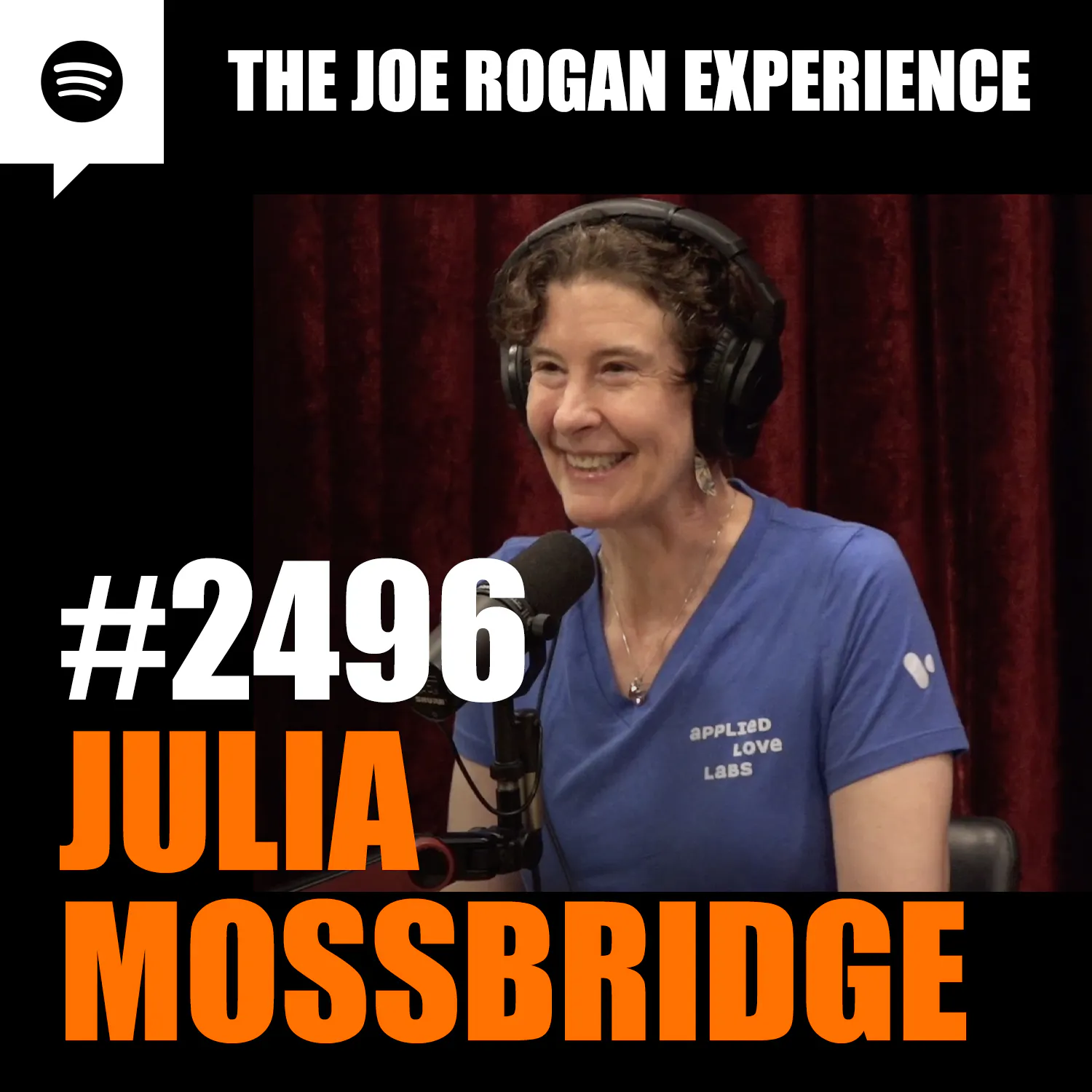 #2496 - Julia Mossbridge
The Joe Rogan Experience · May 8, 2026 · 2 h 49 min
Cognitive neuroscientist Julia Mossbridge tells Joe Rogan about her research on precognition, telepathy among non-speaking autistic people, retrocausal photon experiments, and alleged childhood experimentation in gifted programs.
More from Mayim Bialik's Breakdown
 Part Two: He Called Out to Nonhuman Intelligence at Lake Hartwell. Three Minutes Later, Navy SEALs Watched Two Objects Perform a Maneuver No Terrestrial Craft Could Make | Sean Webb
Oct 7, 2026 · 52 min
Sean Webb tells Mayim Bialik and Jonathan Cohen about receiving information from nonhuman intelligence, AI emotions and alignment, and Jesus and quantum mechanics.
 Part Two: You Have Never Seen Reality: Discover Who You Actually Are in Only Two Minutes | Rupert Spira
Sep 30, 2026 · 51 min
Mayim Bialik and Jonathan Cohen continue their conversation with nonduality teacher Rupert Spira on enlightenment, consciousness, synchronicity, relationships, death, and the soul.
 Re-Air: Embrace Your Eccentricities & A Petri Dish of Creativity | Rainn Wilson
Sep 25, 2026 · 55 min
Rainn Wilson tells Mayim Bialik and Jonathan Cohen about his alienated nerdy childhood, anxiety and addiction, therapy, 12-step programs and the Baha'i faith.
 Part Two: Cult Leaders Target You At Your Weakest. Never Confess This To Them | Rick Alan Ross
Sep 23, 2026 · 59 min
Mayim Bialik and cult expert Rick Alan Ross discuss coercive control in relationships, workplaces and UFO groups, Tulsi Gabbard's ties to Chris Butler, and whether MAGA is a cult.
 Cult Leaders Target You At Your Weakest. Never Confess This To Them | Rick Alan Ross
Sep 22, 2026 · 51 min
Mayim Bialik talks with cult expert Rick Alan Ross about how cults recruit and break people down, deprogramming, Scientology, AA, religion and Lev Tahor.
From the publisher
Dr. Edwin C. May (physicist, former director of the U.S. Government's infamous Star Gate remote viewing program, and one of the world's leading researchers into extrasensory perception) reveals what decades of classified research actually uncovered about psychic phenomena. In this episode of Mayim Bialik's Breakdown, he breaks down the science behind remote viewing and telepathy, explains why he believes these phenomena are real, and shares the remarkable evidence that convinced him as a scientist. We discuss: - The truth about the U.S. Government's Star Gate program, why it existed, and what really happened behind the scenes - Why the government became interested in telepathy and whether there was a remote viewing arms race with Russia - Astonishing statistics behind remote viewing experiments, and why many people underestimate just how accurate they were - Incredible cases of remote viewers identifying ships smuggling illegal drugs - Why Dr. May believes around 10% of the population can successfully remote view under double-blind laboratory conditions - Why no personality test, intelligence test, psychological evaluation, or health assessment ever predicted who would become a successful remote viewer - How new remote viewers were discovered and tested using rigorous scientific protocols - Biggest divide within today's remote viewing community, and why he disagrees with many modern training methods - Why remote viewers can't simply predict lottery numbers - Which types of information are easiest and hardest to perceive through remote viewing - Who tends to become the best remote viewers and whether meditation actually improves performance - His take on Lisa Kudrow's surprising remote viewing experience Dr. May also explains the physics he believes may underlie psi phenomena, including: - His scientific model for how telepathy and remote viewing could work - Why these models are scientifically testable, not just philosophical speculation - How entropy may play a cr…
Summary, chapters and key points were generated from the episode transcript on October 10, 2026. Quotes are checked word for word against the transcript.