
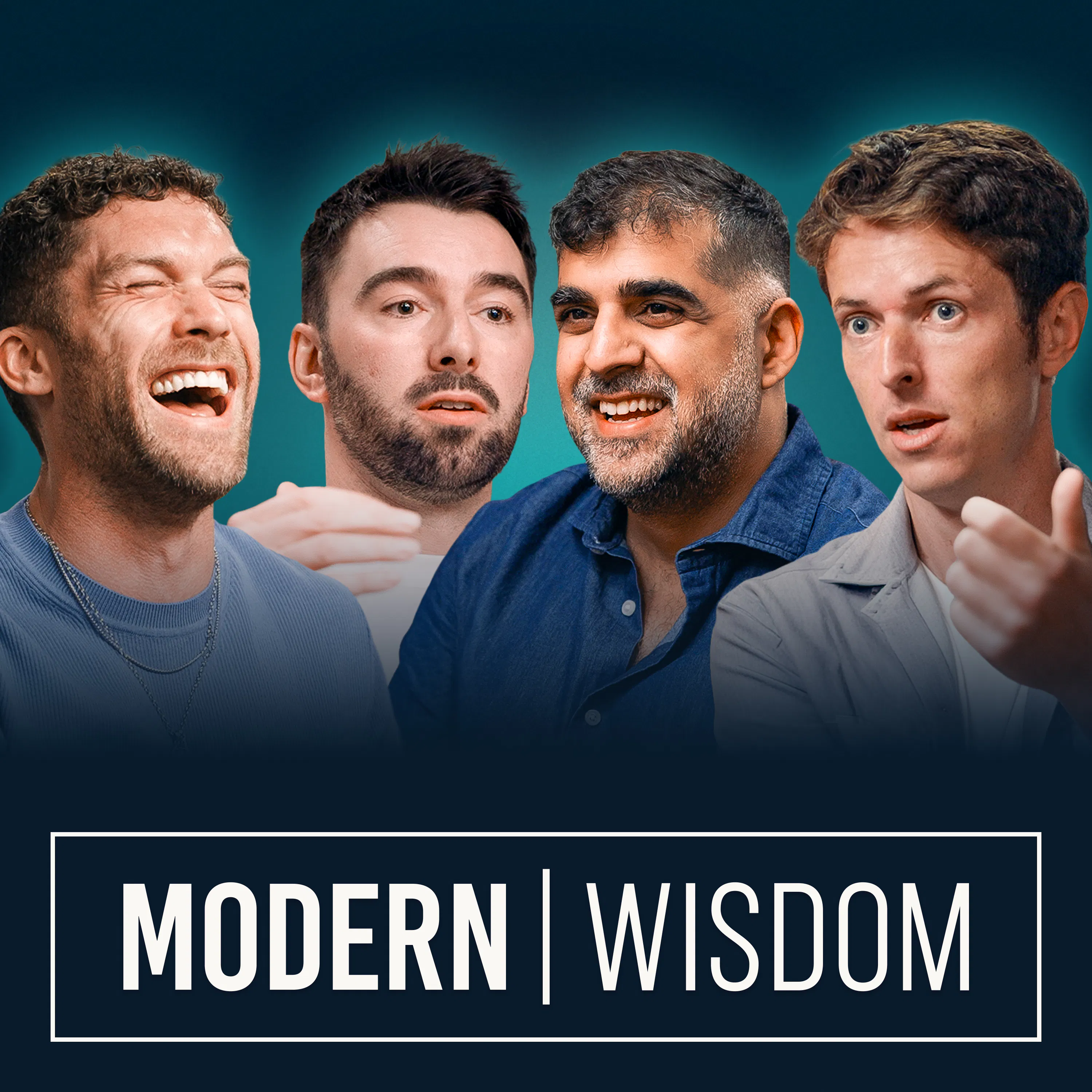
Why Atheists Keep Finding God (in everything) - Alex O’Connor - #1175
Episode of Modern Wisdom · November 12, 2026 · 1 h 57 min
Alex O'Connor tells Chris Williamson why consciousness undermines materialism, how mysticism and prayer work, and discusses embryo selection, the non-identity problem, and fantasy as cheating.
Summary
Philosopher and YouTuber Alex O'Connor joined Chris Williamson to discuss his shift from combative atheism toward a softer agnosticism. O'Connor said he now prefers the label agnostic because it is hard to claim the universe is made of consciousness without something "weird" going on, and argued that philosophy of religion is ultimately experiential, citing Thomas Aquinas abandoning the Summa Theologica and Blaise Pascal's 1654 night of fire. The pair also revisited Ayaan Hirsi Ali's conversion story and Richard Dawkins's response, with O'Connor defending both historical-claims and experiential approaches while warning against critiquing one with the other.
Much of the conversation focused on consciousness. O'Connor argued that consciousness is impossible to define, that science, being a descriptive and mathematical enterprise, can never explain subjective experience, and that materialism is close to indefensible because science describes behaviour rather than substance. He critiqued emergence arguments, claiming every example of emergence offered is something that emerges within consciousness, and expressed sympathy for idealism over panpsychism and traditional monotheism, drawing on Kant, Schopenhauer, Spinoza, Thomas Nagel and the Brahman concept in Hinduism.
O'Connor suggested meditation and psychedelics strip away concepts, and argued that petitionary prayer and grace mainly serve to align the person praying with what they should care about. In a closing ethics segment, he expressed deep unease about genetic enhancement and embryo selection, citing perfectionism and the idea of parental "buyer's remorse," and explained Derek Parfit's non-identity problem. On fidelity, he argued that the wrong in cheating lies in volition and indulged desire, said committed partners should avoid pornography, and claimed pornography harms women most. He closed by promoting his North American tour.
Chapters
- 0:22
From debate bro to compassionate critic
O'Connor explains why he avoids militant fervour, now calls himself agnostic, and why religious people say he has helped their faith.
- 3:35
Bad reasons, relative motion and religious experience
Discussion of believing for poor reasons, geocentrism as a reference frame, and philosophers like Aquinas and Pascal abandoning argument after mystical experience.
- 13:05
Kindness in criticism: Hirsi Ali and Dawkins
Williamson recalls Richard Dawkins questioning Ayaan Hirsi Ali's conversion, and O'Connor argues historical and experiential approaches talk past each other.
- 18:35
Prehistoric religion and gods versus God
O'Connor distinguishes animistic small-g gods from the monotheistic ground of being and speculates on how the Greeks believed in their gods.
- 27:54
Consciousness cannot be defined
O'Connor argues consciousness is the foundational philosophical question and is impossible to define or point at.
- 33:58
The limits of science and materialism
Using Newton's gravity and Russell's atoms, O'Connor argues science describes behaviour, not substance, making materialism hard to defend.
- 50:12
Consciousness, God and mysticism
O'Connor links mystical unity experiences to idealism, Brahman and Spinoza's God or Nature.
- 53:53
Meditation, psychedelics and perception
They discuss how meditation and psychedelics remove concepts, Molyneux-style blindness experiments, Nagel's bat, and Kant and Schopenhauer.
- 1:13:15
Against emergence; toward idealism
O'Connor argues emergence examples all occur within consciousness and favours idealism over panpsychism and monotheism.
- 1:26:40
What prayer is for
Prompted by a joke about AI agents praying, O'Connor argues prayer aligns the believer's will, citing Gethsemane and secular grace.
- 1:31:36
Genetic enhancement and the non-identity problem
They debate embryo selection and enhancement, perfectionism, buyer's remorse and Parfit's non-identity problem.
- 1:42:38
Fantasy, pornography and cheating
O'Connor argues the wrong of cheating lies in indulged desire and that pornography harms relationships and especially women.
- 1:54:09
Tour and upcoming projects
O'Connor promotes his North American tour and plans for more video essays.
Key points
What was said, by whom, with the exact words. Timestamps jump to the moment.
- Alex O'Connor
O'Connor says he would love for Christianity or other religious traditions to be true and is open to it.
“i have always said that i'd love for christianity to be true or you know i'd love for for a number of religious traditions to be true”
- Alex O'Connor
O'Connor says he now prefers to call himself an agnostic because claiming the universe is made of consciousness suggests something strange is going on.
“I prefer to call myself an agnostic now because it's very difficult to claim that the universe is made out of consciousness”
- Alex O'Connor
O'Connor argues philosophy of religion makes no progress because it is an experiential phenomenon rather than a consensus-building enterprise.
“There's no progress to be made because philosophy is not about establishing consensus through arguments which cannot be refuted. It's an experiential phenomenon”
Linked moment · 27:54Skip to 27:54 using a listen link in the info box.
Alex O'ConnorO'Connor argues consciousness is the foundational question of philosophy because everything is experienced through it.
“The question for me is the foundational question of philosophy, I think, is consciousness. because everything comes through consciousness”
- Alex O'Connor
O'Connor maintains that consciousness is literally impossible to define.
“It's also impossible to define. I think it's literally impossible to define”
- Alex O'Connor
O'Connor argues that the nature of science entails that it will never explain consciousness, and people overestimate its scope.
“I think it entails it. I think that science is extremely good at doing what it does, but people are over-optimistic about its possible extent”
- Alex O'Connor
O'Connor argues that because science moves toward objectivity and consciousness is subjectivity, scientific description moves away from consciousness.
“the less subjective you get and the more objective you get in your description, the further away you're getting from consciousness”
- Alex O'Connor
O'Connor says the study of consciousness has made materialism, rather than atheism, nearly impossible to defend.
“materialism, which often goes alongside atheism, is, I think, pretty impossible to defend as a theory of the world”
- Alex O'Connor
O'Connor suggests meditation lets people step outside their concepts, similar to what psychedelics do.
“what meditation probably does for people is it allows them to kind of step outside of their concepts”
- Alex O'Connor
O'Connor holds that consciousness itself is simple awareness that can manifest complexly, and that assuming it needs complexity is a mistake.
“It's one of the biggest mistakes people make is thinking that consciousness requires complexity. I think consciousness itself is extremely simple”
- Alex O'Connor
O'Connor argues that every example offered for emergence is something emerging within conscious experience, so it cannot explain consciousness.
“every single example of emergence they ever give is something which emerges in conscious experience”
- Alex O'Connor
O'Connor says he prefers idealism, the view that everything exists within one great mind, over the monotheistic account of consciousness.
“I prefer the view that, if anything, this view points to the view that there is kind of one great big mind”
- Alex O'Connor
O'Connor argues petitionary prayer is mainly for the person praying, as a way to align oneself with the will of God.
“they're for you. Prayer is an opportunity to align yourself with the will of God”
- Chris Williamson
Williamson argues that once one accepts selecting against harmful traits, it is hard to oppose selecting for positive traits.
“it becomes a very difficult position to hold that we shouldn't continue selecting against negative traits all the way into selecting for positive traits”
- Alex O'Connor
O'Connor warns that genetic selection of children risks an endless pursuit of perfection akin to cosmetic surgery obsession.
“That's what we'll be doing to our children if we're not careful because there's no point at which it stops”
- Alex O'Connor
O'Connor vows to resist any technology that could lead parents to feel buyer's remorse about their children.
“is something that I will resist with every single inch of my soul until the day I die”
- Alex O'Connor
O'Connor argues people serious about a relationship should avoid pornography because indulged desire is the harmful part of cheating.
“if you're serious about a relationship, you should be shutting that kind of thing down. You shouldn't be watching pornography”
- Alex O'Connor
O'Connor contends that pornography is mostly bad for women, a point he says is overlooked in discussions centred on men.
“People talk about, oh, the badness of pornography because look how lustful it makes men. Actually, porn's really bad for women”
People
In the conversation
- Chris WilliamsonBritish podcaster and host of Modern Wisdom
- Alex O'ConnorBritish atheist philosopher and YouTuber, formerly Cosmic Skeptic
Discussed
- Joe SchmidYouTube philosopher who converted to Catholicism
- Thomas Aquinas13th-century Dominican theologian and philosopher
- Blaise Pascal17th-century French mathematician and philosopher
- Anselm of CanterburyMedieval theologian who formulated the ontological argument
- Ayaan Hirsi AliSomali-born Dutch-American writer and former New Atheist who converted to Christianity
- Richard DawkinsEvolutionary biologist who coined the terms "meme" and "viruses of the mind"
- Thomas NagelAmerican philosopher, author of 'What Is It Like to Be a Bat?'
- Isaac NewtonEnglish physicist who unified terrestrial and celestial mechanics
- Immanuel KantGerman philosopher who distinguished phenomena and noumena
- Arthur SchopenhauerGerman philosopher who identified the thing-in-itself with will
- Baruch SpinozaDutch philosopher known for 'God or Nature'
- Derek ParfitBritish philosopher who identified the non-identity problem
- Carlo RovelliItalian theoretical physicist specializing in quantum gravity and author of popular science books
- Bertrand RussellBritish philosopher and logician
- JesusFounder figure of Christianity
Topics
Related episodes
 #447 - NASA Study Confirms "Predatory" Plasma Beings & Von Braun's Alien Warning | Jay Anderson
Danny Jones Podcast · Nov 9, 2026 · 3 h 28 min
Danny Jones and Project Unity creator Jay Anderson discuss UFO secrecy, Anderson's orb sightings, plasma life, ancient Egyptian and Peruvian mysteries, and social media manipulation.
 Part Two: Atheist Dies on the Operating Table, Meets Her Spirit Guide, and Sent Back With 12 Messages to Share on Love, Connections & Why We Are Never Alone | Nancy Rynes
Mayim Bialik's Breakdown · Nov 4, 2026 · 1 h 14 min
In part two, near-death experiencer Nancy Rynes tells Mayim Bialik and Jonathan Cohen about her spirit guide, soul contract, life review, recovery, alternate timelines and remote viewing.
 Atheist Dies on the Operating Table, Meets Her Spirit Guide, and Sent Back With 12 Messages to Share on Love, Connections & Why We Are Never Alone | Nancy Rynes
Mayim Bialik's Breakdown · Nov 3, 2026 · 58 min
Former atheist geologist Nancy Rynes tells Mayim Bialik and Jonathan Cohen about her 2014 bike crash, out-of-body split consciousness, and near-death experience during spinal surgery.
 Mustafa Suleyman: AI Should Serve Humanity, Not Replace It
The Builders · Oct 29, 2026 · 52 min
Walter Isaacson interviews Microsoft AI CEO Mustafa Suleyman live at 92NY about AI consciousness, his disagreement with Anthropic, containment, safety red lines and AI's purpose.
 Part Two: The Alien Invasion Already Happened. JFK, The CIA & Who’s Really Controlling History | Peter Levenda
Mayim Bialik's Breakdown · Oct 28, 2026 · 48 min
Author Peter Levenda tells Mayim Bialik and Jonathan Cohen about MKUltra, Nazi occultism, UFOs as consciousness manipulation, and his own Men in Black encounters.
 Positive Psychology Founder: How To Stop Your Negative Thoughts - Martin Seligman - #1167
Modern Wisdom · Oct 24, 2026 · 1 h 21 min
Chris Williamson talks with psychologist Martin Seligman about learned helplessness, optimism, his new book Agency, AI and creativity, and the Axial Age.
More from Modern Wisdom
 How To Turn Your Pain Into Greatness - Bugzy Malone - #1174
Nov 9, 2026 · 2 h 8 min
Chris Williamson talks with rapper Bugzy Malone about making it versus maintaining it, childhood trauma, fear, accountability, faith, and his move into acting.
 How War Shaped Human Evolution - David Geary - #1172
Nov 5, 2026 · 1 h 12 min
Evolutionary psychologist David Geary tells Chris Williamson how male coalitional warfare, status competition, and technology shaped human brain evolution and modern behavior.
 How To Make Better Decisions (with way less uncertainty) - Joe Hudson - #1171
Nov 2, 2026 · 1 h 43 min
Chris Williamson talks with coach Joe Hudson about why decision-making is emotional, how fear distorts choices, and how principles, iteration and emotional acceptance improve decisions.
 35 Emotions Explained By Evolutionary Psychology - Rob Kurzban - #1169
Oct 29, 2026 · 2 h 28 min
Chris Williamson and evolutionary psychologist Rob Kurzban explain dozens of emotions, from itchiness and disgust to envy, depression, and gratitude, through evolutionary function.
 Crypto Scams, Dopamine Websites, Tasteful Slop & Vape Shop Energy - Rabbit Hole #6 - #1168
Oct 26, 2026 · 2 h 8 min
Chris Williamson, Shaan Puri, Jack Butcher and George Mack riff on crypto memecoins, prediction markets, dopamine websites, taste versus slop, AI agents, kids and devices, and product-market fit.
From the publisher
Alex O’Connor is a YouTuber, writer and a podcaster. Expect to learn what shifts happened in Alex’s thinking these past few years, why you actually would ever want to time travel, why so many people are moving away from atheism, why consciousness is the biggest hole in the atheist argument, what meditation really does to your conscious mind, if there is a practical point to prayer, if watching porn is considered cheating, and much more... Get tickets to Alex’s North American Tour this month for an evening of discussion and audience questions on philosophy, God, religion, consciousness, and more: https://www.alexoconnor.com/tour. Sponsors: Get 160+ lab tests for just $365 and save an extra $25 at https://functionhealth.com/modernwisdom Get 35% off your first subscription to the best supplements from Momentous at https://livemomentous.com/modernwisdom Sign up for a free trial from Shopify at https://shopify.com/modernwisdom Get 15% off your first order of my favourite Non-Alcoholic Brew at https://athleticbrewing.com/modernwisdom See discounts for all the products I use and recommend: https://chriswillx.com/deals Get ChatGPT to explore ideas, solve problems, and learn faster at https://chatgpt.com Timestamps: (00:00) Should We Debate With Compassion? (03:00) Is Philosophy Bringing People Back to Religion? (13:05) Are We Becoming Kinder in Our Criticisms? (19:34) Did Religion Exist 150,000 Years Ago? (27:54) Is Consciousness Impossible to Define? (42:24) Will Science Ever Answer These Questions? (50:12) Is Consciousness Evidence of God ?(53:52) What Really Happens When You Meditate? (01:00:17) How Our Senses Construct Reality (01:13:47) What Lies at the Foundation of Reality? (01:22:05) How Are Consciousness and Religion Connected? (01:26:42) What Is Prayer Actually For? (01:31:36) Is Genetically Engineering Traits Unethical? (01:42:37) Does Fantasising About Someone Else Count as Cheating? (01:54:08) Where to Find Alex Extra Stuff: Get my free reading…
Summary, chapters and key points were generated from the episode transcript on November 15, 2026. Quotes are checked word for word against the transcript.