
Vinh Giang: How to Communicate So People Actually Listen to You
Episode of On Purpose with Jay Shetty · October 26, 2026 · 1 h 38 min
Jay Shetty talks with communication coach Vinh Giang about listening, vocal and visual presence, confidence, and practical conversation techniques from his first book.
Summary
Communication expert Vinh Giang returned to On Purpose to discuss his first book, Before We Forget How to Connect. The pair opened by playing Giang's "high-low buffalo" icebreaker: Shetty shared his satisfaction with his team and his grief over a mentor who died of brain cancer, while Giang spoke about his children playing together, cousins battling cancer, and his hobby of doomsday prepping. Giang used the exercise to explain "conversational threads" and argued that people get stuck in small talk because they fail to notice and pull on these threads.
Giang described listening as having four modalities—words, vocal changes, body language, and sensing feeling—and demonstrated a "last word, last letter" game to train attention. He recommended asking three follow-up questions whenever someone shows peak emotion, meeting people where they are at first impressions, and building a personal list of improvements rather than following generic formulas. He likened communicators to chefs who first emulate others before developing their own style, and Shetty recounted studying stand-up comedians and Adele for stage technique.
On presence, Giang argued that a monotone voice comes from a monotone body, that the face acts as the "remote control" for vocal emotion, and that standing and pausing in meetings deters interruption. He explained why people dislike their recorded voice and video image, advised pausing and asking clarifying questions when the mind goes blank, and argued that confidence is best reached by controlling how one looks and sounds rather than how one feels. Shetty shared accounts of speaking before 1,000 colleagues in 2014 and of pre-show nerves on his 2023 world tour.
In a listener-scenarios segment, Giang offered advice on first dates, arguments with partners, speaking up in meetings with a "one thing" framework, joining conversations, and exiting them gracefully. He closed by saying the book let him share vulnerable stories he cannot yet tell aloud.
Chapters
- 0:01
Welcome and the challenge of writing a book
Shetty introduces Giang and his first book, and Giang describes the difficulty of conveying voice and pause in writing.
- 1:52
Playing high-low buffalo
The two share personal highs, lows, and surprising facts, including a late mentor, family cancer, GTA 6, and doomsday prepping.
- 13:50
Conversational threads and self-judgment
Giang explains how pulling on threads escapes small talk, and both discuss sharing wins and struggles without self-editing.
- 20:35
Gen Z and the last word, last letter game
Giang argues communication is an untaught but learnable skill and demonstrates a listening game with Shetty.
- 27:39
Four modalities of listening and the three-question rule
Giang outlines listening to words, voice, body language and feeling, and recommends three follow-up questions after peak emotion.
- 35:47
First impressions and finding your voice
Giang advises meeting people where they are, avoiding generic formulas, and emulating speakers before developing a personal style.
- 48:46
Life as a book and new chapters
Giang shares a mentor's metaphor about life's chapters and urges introverts not to repeat behaviors from past chapters.
- 51:57
Executive presence and resting blank face
Giang explains vocal and visual presence, standing to avoid interruption, and how facial expression drives vocal emotion.
- 58:24
Filming yourself and handling blank moments
They discuss self-recording, why people dislike their recorded voice, and pausing and clarifying when put on the spot.
- 1:06:54
The pause and sounding confident
Giang argues familiarity builds comfort with pauses and that confidence comes from controlling look and sound, as Shetty recounts his stage nerves.
- 1:17:10
Real-life listener scenarios
Giang answers listener questions on dates, arguments, speaking up in meetings, joining and leaving conversations.
- 1:31:18
Magic, simplicity, and vulnerable stories
Giang draws on his magician past to stress simple solutions and describes sharing harder personal stories in the book.
Key points
What was said, by whom, with the exact words. Timestamps jump to the moment.
- Vinh Giang
Giang recounts learning from his cousin with cancer that support sometimes means sharing fear rather than fixing things.
“I just want you to sit in the dark with me and just be scared with me. Whereas I tried to be brave all the time”
- Vinh Giang
Giang argues people get trapped in small talk because they never learn to perceive the conversational threads others offer.
“I think the only reason why people get trapped in small talk is because they've never learned to hear, see, feel, and sense these threats”
Linked moment · 17:14Skip to 17:14 using a listen link in the info box.
Jay ShettyShetty advises people not to judge whether their highs or lows are significant enough before sharing them.
“Don't judge your answer before you put it out into the world, because if it's a friend, a colleague or a family member, chances are they're not going to judge you for it”
- Vinh Giang
Giang argues communication habits are learned behaviors that can be unlearned and replaced, not permanent traits.
“the way you communicate is just a series of behaviors that you've learned from other people that you've been repeating for the last 5, 10, 20, 30, 40 years of your life”
- Vinh Giang
Giang says the last word, last letter game reveals that people usually plan their response instead of listening.
“We're already thinking about our response that we want to give. Whereas this game forces you, you can't think of what you want to say until I finish”
- Vinh Giang
Giang argues that being engaging requires playing one's voice and body well, using a Beethoven metaphor.
“You can have the greatest music written by Beethoven, but if you don't play it well, it won't be perceived that way”
- Vinh Giang
Giang recommends asking three follow-up questions whenever you sense a peak emotion in someone.
“Once you sense it, three follow-up questions there that make sense. Just three”
- Vinh Giang
Giang contends that adjusting your energy to match a group at first meeting is considerate rather than fake.
“That's not fake and phony. That's you adjusting yourself to be able to meet people where they are, which is to me an incredible sign of a great communicator”
- Vinh Giang
Giang says he avoided top-ten lists in the book because generic advice produces generic results.
“But I worry about that because general advice leads to general results”
- Vinh Giang
Giang advises standing when it is your turn to speak in meetings, since a standing speaker who pauses is rarely interrupted.
“And when you're standing and you pause, no one interrupts you. Why? Because we all understand if that person's still standing, they're still talking”
- Vinh Giang
Giang argues a monotone voice stems from a monotone body and that facial expression controls vocal emotion.
“everyone's afraid of this monotone voice without realizing that a monotone voice comes from a monotone body”
- Vinh Giang
Giang explains people dislike their recorded voice because they normally hear it resonating through bone and muscle rather than air.
“when you hear yourself in your own head, you're hearing your voice vibrate through muscle tissue and bone tissue, which creates a more resonant, deeper, richer sound”
- Vinh Giang
Giang says people often go blank because the question asked was too broad, and recommends seeking specificity before answering.
“recognize that, and instead of reaching for an answer straight away, reach for specificity”
- Vinh Giang
Giang argues that controlling how you look and sound is easier than controlling feelings and influences confidence.
“So as you start to control the way you look and the way you sound, inevitably, it impacts the way you feel”
- Jay Shetty
Shetty recounts that despite 20 years of speaking he still felt nauseous with nerves before his first world tour show in 2023, relying on posture, breathing and a strong opening.
“At this point, I've spoken on stages for 20 years and I'm still stressed out. And I still felt not confident”
- Vinh Giang
Giang advises partners in arguments to address the situation rather than attack the person, and to reflect back the other's emotion.
“Don't attack them. Talk to the situation that is currently happening in front of you. Speak to the situation”
- Vinh Giang
Giang recommends opening contributions in meetings with a 'one thing' framing to stay concise and avoid rambling.
“hey, if there's one thing I wanted to share, if there's one thing I had to share, it would be this. And just share one thing”
- Jay Shetty
Shetty argues people listen better when a headline precedes the explanation, as in social media and YouTube.
“I think we listen more when there's a headline before an explanation”
- Vinh Giang
Giang claims the people who get promoted most are the most visible ones who contribute clearly in meetings.
“Who are the people who get promoted the most at work? The people who are the most visible”
- Vinh Giang
Giang suggests leaving a conversation by reflecting on what was said, citing a time constraint, and asking one final question.
“Hey, I've got to go, but I want to ask you one more thing about your Labradoodle”
- Vinh Giang
Giang says writing the book let him share painful stories he still cannot tell aloud, after overvaluing positivity in his public persona.
“allowed me to write some stories in it that still hurt, that I'm not really able to share verbally and out loud yet”
People
In the conversation
- Jay ShettyBritish author, podcast host and former monk who hosts On Purpose
- Vinh GiangAustralian communication coach, former magician, and author of Before We Forget How to Connect
Discussed
- Cristiano RonaldoPortuguese footballer who played for Manchester United, Real Madrid and Juventus
- Piers MorganBritish broadcaster who criticized the Balogun decision
- Adam CheyerCo-creator of Siri and mentor to Giang who shared a life-as-a-book metaphor
- John WoodenUCLA basketball coach with ten national titles
- Steve MartinAmerican comedian, Randolph's Only Murders in the Building co-star
- AdeleBritish singer Shetty cited as a model of on-stage humor between songs
- Will GreenwoodEnglish Rugby World Cup winner who spoke alongside Shetty at a 2014 company event
- Tony RobbinsAmerican life and business coach, entrepreneur and bestselling author
Topics
More from On Purpose with Jay Shetty
 EZRA FRECH: "I Was Put on This Earth to Change the Way We See Disability"
Oct 19, 2026 · 1 h 46 min
Jay Shetty interviews Paralympic champion Ezra Frech about growing up with a limb difference, his Paris double gold, visualization, Dancing with the Stars, and adaptive sports advocacy.
 Sabrina Zohar: How to Stop Chasing People Who Don’t Want You
Oct 7, 2026 · 1 h 26 min
Jay Shetty talks with relationship coach Sabrina Zohar about how childhood attachment shapes dating patterns, boundaries versus walls, anxious-avoidant dynamics, and chasing unavailable people.
 MIKAYLA NOGUEIRA EXCLUSIVE: The Story She’s Finally Ready to Tell
Oct 5, 2026 · 2 h 8 min
Beauty creator Mikayla Nogueira tells Jay Shetty about her rise from Ulta makeup artist to viral TikTok star, her addiction-strained marriage and divorce, new love, and her brand POV.
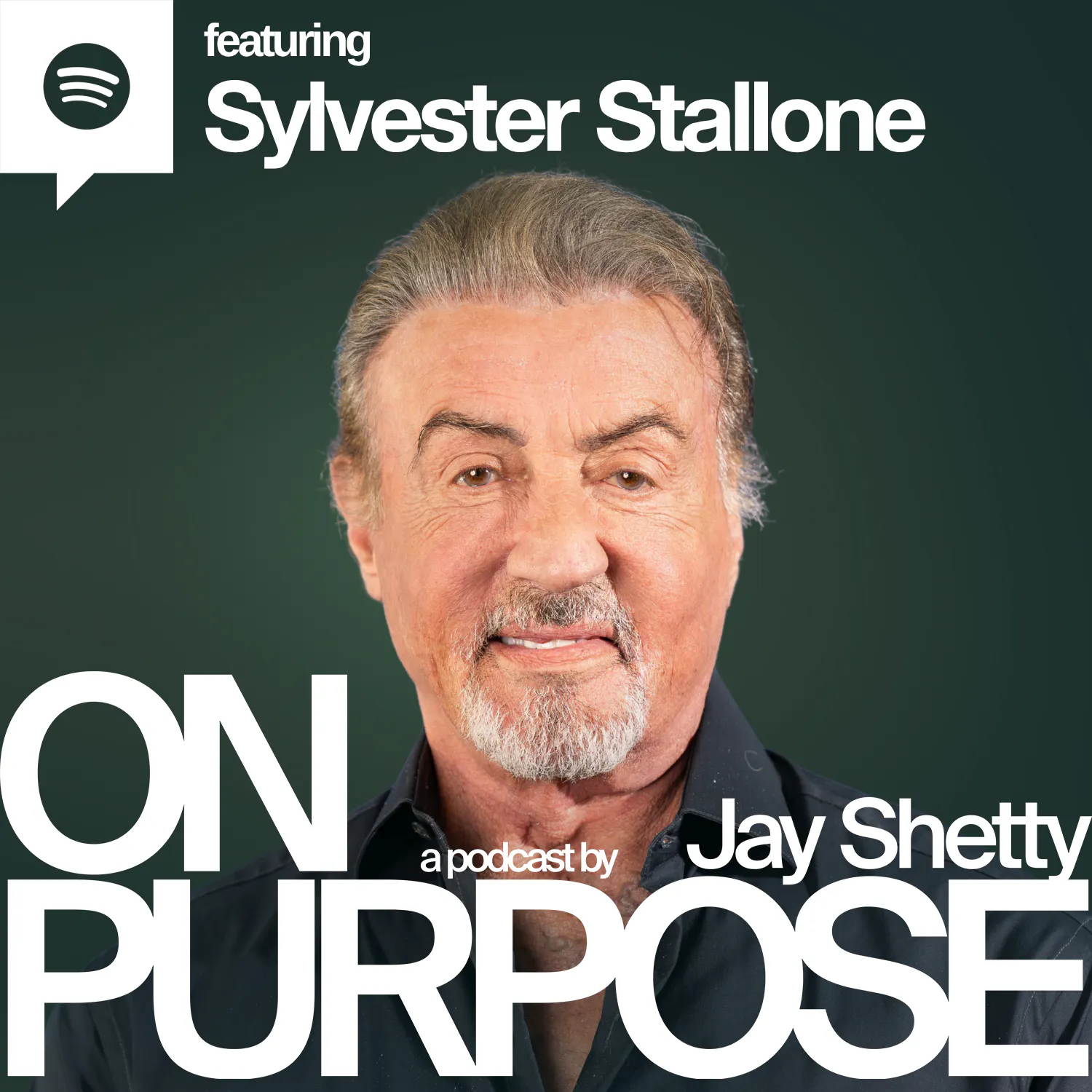 SYLVESTER STALLONE: “I Wasn’t Stupid. I Was Just Misunderstood.”
Sep 28, 2026 · 1 h 29 min
Jay Shetty interviews Sylvester Stallone about his painful childhood, rejection, creating Rocky, his parents, career slumps, health, marriage and his memoir The Steps.
 LUCY HALE: “I Was Sabotaging My Life.”
Sep 21, 2026 · 1 h 24 min
Actress Lucy Hale tells Jay Shetty about self-sabotage, early fame, four years of sobriety, freezing her eggs and finding healthy love.
From the publisher
Communication expert Vinh Giang joins Jay to share practical tools from his first book, Before We Forget How to Connect, to help you become a more confident communicator and build deeper, more meaningful connections. Vinh explains how to become a better listener, avoid common communication mistakes, and speak so people actually pay attention. From sounding confident when you're nervous to speaking up in meetings, navigating difficult conversations, and making a great first impression, Vinh shares simple techniques to help you communicate more effectively and connect with people in every area of your life. With Love and Gratitude, Jay Shetty Instagram Teen Accounts: Built-in protections for teens. JAY'S DAILY WISDOM DELIVERED STRAIGHT TO YOUR INBOX Join 900,000+ readers discovering how small daily shifts create big life change with my free newsletter. Subscribe here: https://news.jayshetty.me/subscribe Check out our Apple subscription to unlock bonus content of On Purpose! https://lnk.to/JayShettyPodcast What We Discuss: 00:00 Introduction 00:25 Before We Forget How To Connect 01:52 The High-Low Buffalo Icebreaker 02:45 Sharing Personal Highs 05:15 Sharing Personal Lows 11:40 Sharing Personal Buffalos 13:40 Escaping Small Talk 16:10 Overcoming Self-Judgment 17:58 Sharing Wins Without Sounding Arrogant 19:50 Communication Beyond The Script 20:40 Gen Z's Communication Struggles 23:20 Last Word, Last Letter Game 27:20 The Four Modalities Of Listening 29:50 The Three Follow-Up Questions Rule 35:50 How Do You Make A Great First Impression? 40:10 Reading the Room, Not Formulas 44:10 Finding Your Unique Voice 49:00 Life As A Book: New Chapters 50:40 Building Executive Presence 53:20 Fix Your Resting Blank Face 58:30 Filming Yourself For Self-Awareness 01:02:20 When Your Mind Goes Blank 01:06:10 The Power Of The Pause 01:09:30 How Can You Sound Confident When You’re Nervous? 01:14:40 From Texting Chemistry to Real-Life Connection 01:18:40 How to Communicate Better During Ar…
Summary, chapters and key points were generated from the episode transcript on November 1, 2026. Quotes are checked word for word against the transcript.