
Peter Thiel: “We Need to Hit the Accelerator as Hard as Possible” on AI
Episode of The Builders · October 22, 2026 · 58 min
Walter Isaacson interviews Peter Thiel on the AI backlash, existential risk, his Antichrist lectures, founder-led companies, René Girard, and why he prefers evil to incompetence.
Summary
Walter Isaacson spoke with investor Peter Thiel about the recent backlash against artificial intelligence. Thiel traced AI safety concerns to Bay Area rationalist and effective altruist circles, which he said got "one enormously big thing right" in foreseeing AI, and credited that milieu with producing Anthropic. He argued AI would raise productivity and be disinflationary, that the fierce competition among labs makes monopoly capture unlikely, and that public anxiety stems from volatility and disruption rather than aggregate harm.
Thiel said he remained outside the "pause button camp" and that the U.S. must "hit the accelerator as hard as possible," largely because of competition with China's high-tech totalitarianism. He suggested AI companies' calls for regulation may be cynical or motivational, recounting telling Mark Zuckerberg that Congress wanted to yell at him rather than regulate him. Explaining his Antichrist lectures, he framed the choice as "Antichrist or Armageddon," warning that fear of catastrophe could justify a softly totalitarian one-world government, and criticized Eliezer Yudkowsky's call for global AI regulation as vague.
The conversation turned to founders versus bureaucrats, with Thiel arguing companies are bimodal and ranking Elon Musk and Steve Jobs above Tim Cook for society. He discussed stagnation in the "world of atoms," his hesitation on Ross Douthat's question about humanity's survival, René Girard's mimetic theory, and his ranking of good over evil but evil over "bad," illustrated through the Faust of Goethe and Marlowe. He closed by naming consciousness and relationality as distinctively human, saying he does not believe AI is or will be conscious.
Chapters
- 2:27
Introduction
Isaacson frames the series and introduces Thiel as a controversial "builder of builders."
- 5:38
The AI backlash and effective altruism
Thiel explains the roots of AI fears in Bay Area rationalist and effective altruist circles and the founding of OpenAI and Anthropic.
- 11:18
Jobs, productivity and monopoly
Thiel predicts AI will boost productivity and argues intense competition among labs makes monopoly capture unlikely.
- 16:14
China and the pause debate
Thiel rejects pausing AI, citing Chinese high-tech totalitarianism and the need for growth, and contrasts technology with globalization.
- 25:31
Doomsday risk and calls for regulation
Thiel dismisses high extinction probabilities and questions the motives behind AI companies' calls for regulation, recalling advice to Zuckerberg.
- 29:39
The Antichrist and one-world government
Thiel explains his Antichrist framing as a warning against global totalitarian authority justified by fear of Armageddon.
- 36:47
Founders versus bureaucrats
Thiel defends charismatic founders as the alternative to bureaucratic management and describes his own motivations.
- 41:01
The purpose of progress
Thiel discusses stagnation in the world of atoms, medicine, and his hesitation on whether humanity should survive.
- 50:08
René Girard and mimesis
Thiel explains mimetic desire and links non-mimetic vision to builders like Musk and Jobs and to AI.
- 56:40
Evil versus bad
Thiel argues that competent evil is preferable to incompetence, drawing on Goethe's and Marlowe's Faust.
- 1:02:51
What humans uniquely do
Thiel names consciousness and relationality as distinctively human capacities AI cannot replace.
Key points
What was said, by whom, with the exact words. Timestamps jump to the moment.
- Peter Thiel
Thiel argues that the effective altruists, despite cult-like aspects, correctly foresaw that AI was coming and built a hugely valuable company in Anthropic.
“So if you have a cult that's built a company that's worth probably close to $2 trillion at the IPO”
- Peter Thiel
Thiel predicts AI will substantially increase productivity and act as a disinflationary force.
“I think in aggregate, on a macroeconomic level, AI will increase productivity a lot. It will be a fairly disinflationary force in our economy”
Linked moment · 12:45Skip to 12:45 using a listen link in the info box.
Peter ThielThiel says AI startup pitches are strong on growth but weak on explaining any monopoly, suggesting benefits will be widely distributed.
“they're narratives of growth, of terrific technology. They are incredibly weak on the monopoly story”
- Peter Thiel
Thiel says China is trying out a form of high-tech totalitarianism that should not become the winning model.
“I think there is a certain type of high-tech totalitarianism that's being tried out in China”
- Peter Thiel
Thiel states he opposes pausing AI development and wants maximum acceleration.
“I'm still not in the pause button camp. And I'm saying this on your show that I'm not in the pause button”
- Peter Thiel
Thiel argues that banning AI would leave the U.S. with almost no economic growth, resembling Europe or Japan.
“But I would say if we had outlawed the internet and if we now outlaw AI, there will be virtually no growth”
- Walter Isaacson
Isaacson says he and others correctly believed globalization would produce growth but failed to foresee how many people it would leave behind.
“people, like me, believed in globalization, immigration, free trade, free movement of capital, and we thought it would cause growth. And guess what? It did”
- Peter Thiel
Thiel argues the internet did not generate enough growth and that AI is a bigger technology than the internet.
“The problem in some ways was that the internet wasn't big enough. It added some growth. It wasn't big enough. I think AI is bigger than the internet”
- Peter Thiel
Thiel rejects a 5 to 10 percent probability of AI killing everyone as far too high.
“yes, 5% to 10% sounds way too high for everybody on this planet getting killed. Don't think that's going to happen”
- Peter Thiel
Thiel recounts telling Mark Zuckerberg that Congress wanted to berate him rather than regulate Meta.
“And I told him, you know, they don't want to regulate you. They want to yell at you”
- Peter Thiel
Thiel suggests AI companies may ask for regulation knowing government cannot regulate effectively or quickly.
“Perhaps they know the government doesn't know how to do it and that it will be slow”
- Peter Thiel
Thiel argues that Dario Amodei's warnings about AI danger also serve to motivate Anthropic's employees.
“that's a way to tell all his employees, you're working at the greatest, most important company in the history of the world”
- Peter Thiel
Thiel says a softly totalitarian one-world government should be weighed alongside other existential risks.
“the existential risk that I also want to always throw in the hopper and the balance of the discussion is the risk of a softly totalitarian one world government”
- Peter Thiel
Thiel argues that because people focus on Armageddon rather than global tyranny, more worry about the Antichrist is warranted.
“And my contrarian intuition is that alone tells you you need to worry more about the Antichrist than Armageddon”
- Peter Thiel
Thiel says he prefers the religious framing because it pushes toward avoiding both catastrophe and global tyranny.
“And Antichrist or Armageddon pushes us to find a moderate third way”
- Peter Thiel
Thiel claims companies are either led by charismatic founders or run by bureaucracies, with nothing in between.
“And my claim is it's a bimodal distribution. Those are literally the only two kinds of companies we have”
- Peter Thiel
Thiel judges Elon Musk and Steve Jobs more beneficial to society than Tim Cook.
“But I would still say somehow Elon or Steve Jobs are way better for society than Tim Cook”
- Peter Thiel
Thiel says that by the late 1980s most engineering fields outside computing were poor career choices because the physical world was over-regulated and slow.
“most engineering fields were bad ones to go into, mechanical engineering, aero, astro engineering, chemical engineering, because the world of atoms was too slow, too regulated”
- Peter Thiel
Thiel advocates nuclear power as a carbon-neutral technology to help humanity survive.
“So nuclear power is a technology we need to lean into so that humanity can survive in a more carbon neutral way”
- Peter Thiel
Thiel says he views AI leaders such as Musk, Amodei and Altman as more good than bad and easily scapegoated.
“I score them as far more good than bad across the board. I think they very easily get demonized and scapegoated”
- Peter Thiel
Thiel ranks good above evil but competent evil above incompetence.
“I'm ranking these. I'm good over evil. But evil is better than bad”
- Peter Thiel
Thiel says he does not believe AI is or will ever be conscious.
“vaguely Cartesian in that I don't think AI is conscious or ever will be”
People
In the conversation
- Walter IsaacsonBiographer and author
- Peter ThielInvestor and author of Zero to One
Discussed
- Elon MuskEntrepreneur behind X, xAI and SpaceX, discussed in AI competition
- Sam AltmanCEO of OpenAI, cited by Hudson as an example of a 'maximalist'
- Dario AmodeiAnthropic CEO cited for a publicly stated 25% probability of catastrophic AI outcomes
- Mark ZuckerbergCo-founder of Facebook
- David SacksInvestor and Trump administration AI adviser, longtime friend of Thiel
- Donald TrumpPresident of the United States whose conduct of the Iran war is the episode's main subject
- René GirardFrench philosopher known for mimetic theory
- Eliezer YudkowskyAI safety researcher associated with high P(doom) arguments
- J. Robert OppenheimerDirector of the Los Alamos laboratory during the Manhattan Project
- Nick BostromOxford philosopher who published the 2003 simulation argument
- Steve JobsCo-founder of Apple
- Tim CookApple CEO joining Trump's China trip
- Ross DouthatNew York Times columnist who interviewed Thiel
- Demis HassabisCEO of Google DeepMind, cited for predictions about curing disease
- Greta ThunbergSwedish climate activist
- Bill GatesCo-founder of Microsoft
Topics
Related episodes
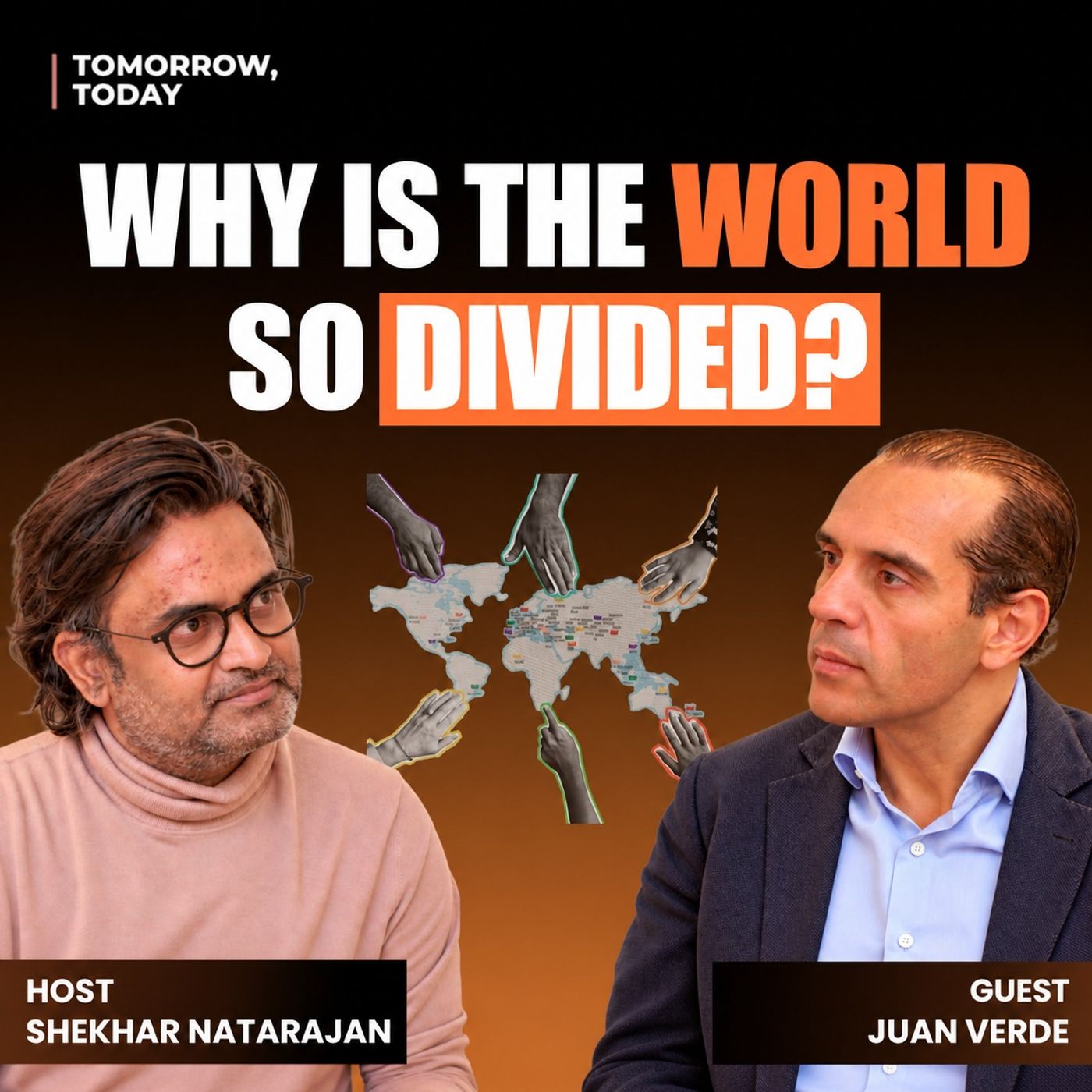 Juan Verde on Politics, Purpose, Leadership, Sustainability and the Future | Shekhar Natarajan
Tomorrow, Today · Oct 22, 2026 · 1 h 15 min
Shekhar Natarajan interviews Juan Verde about his path from the Canary Islands to U.S. politics, globalization, polarization, business sustainability and AI.
 Beyoncé and Usher’s Secret Coach | Nick Cooper | Coffeez with Joe Shalaby Ep. 322
Coffeez with Joe Shalaby · Oct 22, 2026 · 1 h 13 min
Celebrity performance coach Nick Cooper tells Joe Shalaby about his mirror ritual, coaching Beyoncé, screen-free parenting, turning down Oprah, and his father's final words.
 #2569 - Bill Thompson
The Joe Rogan Experience · Oct 21, 2026 · 2 h 53 min
Joe Rogan and Spartan Forge founder Bill Thompson discuss bow hunting, performing under pressure, military survival training, Jungian dreams, mastery, online bots and AI's future.
 MIDDLE MANAGERS ARE BACK?!
We Fixed It, You're Welcome · Oct 20, 2026 · 57 min
Aaron Wolpoff and Melissa Eaton talk with talent expert Abhijit Bhaduri about companies rehiring middle managers after AI-driven flattening, and the damage to trust.
 #2567 - Mariana van Zeller
The Joe Rogan Experience · Oct 16, 2026 · 2 h 30 min
Joe Rogan and journalist Mariana van Zeller discuss romance and pig-butchering scams, Meta's profits from scam ads, Mexican cartels, the opioid crisis and drug policy.
 The Mattering Effect: Success and Mattering Are Not the Same Thing - John R. Miles
Proven Podcast · Oct 10, 2026 · 1 h 6 min
Charles Schwartz talks with former Navy officer and tech executive John R. Miles about leadership, trust, self-regulation, and the six signals of mattering at work.
From the publisher
Peter Thiel has become one of the most mysterious and controversial figures in tech. He’s a visionary investor who recognizes transformative ideas before everyone else. But he’s also seen as a shadowy figure whose network has accumulated extraordinary influence across Silicon Valley, national security and politics– proven by his bets on people like Elon Musk, Alex Karp, Sam Altman, and even Vice-President JD Vance. Walter invites the “builder of builders” and co-founder of PayPal and Palantir, to explain his warnings about the Antichrist, discuss the current moment of AI co-founders speaking out about safety, and to ask Thiel his philosophy on preferring evil founders to incompetent ones. An illuminating conversation with the man whose bets are reimagining tomorrow’s tech and politics. Interview taped September 16, 2026. And be sure to pick up Walter Isaacson’s The Innovators: How a Group of Hackers, Geniuses, and Geeks Created the Digital Revolution , wherever fine books are sold. See omnystudio.com/listener for privacy information.
Summary, chapters and key points were generated from the episode transcript on October 23, 2026. Quotes are checked word for word against the transcript.