
#2549 - Jared Diamond
Episode of The Joe Rogan Experience · September 3, 2026 · 2 h 34 min
Jared Diamond talks with Joe Rogan about leadership, the rise of world religions, the origins of writing, language, and cannibalism and Kuru in New Guinea.
Summary
Jared Diamond joined Joe Rogan to discuss his book "Profits, Prophets, Coaches, and Kings" and the question of when individual leaders change history. Diamond said his interest stemmed from growing up during the Second World War and later living in Chile before Pinochet's coup, and argued that leaders matter when they are at the right time and place, citing Winston Churchill, Bill Gates, Jeff Bezos, Mark Zuckerberg and Genghis Khan, whose rise he linked to tree-ring evidence of an unusually wet decade on the Mongolian steppe.
Applying this framework to religion, Diamond argued that theology was rarely decisive in a faith's spread. He credited Christianity's success to its universal message, St. Paul's organizational skill, higher Christian birth and survival rates in the Roman Empire, and Christian literacy, and attributed Mormon growth to Brigham Young's organization, tithing and missionary service rather than Joseph Smith's teachings. He also reconciled the book with "Guns, Germs, and Steel" by saying continental-scale outcomes over 10,000 years do not depend on individuals, while religion is the rare case where one person's beliefs persist for millennia.
A long middle section covered language and writing. Diamond described translation losses (the Greek "logos", Italian's two words for love, the Iliad's opening line), tonal languages in New Guinea, the Korean Hangul system invented by King Sejong, the independent inventions of cuneiform, Mesoamerican and Chinese writing, the loss of Linear B in the Bronze Age collapse, and Sequoyah's Cherokee syllabary. He also explained how pidgin languages become full creoles within a decade through children, drawing on New Guinea Tok Pisin and Hawaiian plantation history.
Diamond then recounted fieldwork among the Fore of Papua New Guinea, describing endocannibalism, the transmission and long latency of Kuru, and the ritualized homosexual initiation of boys in some highland tribes. He closed with a chapter from his book on Seretse Khama, whom he argued was uniquely able to abolish chiefly power in Botswana and nationalize newly discovered diamond wealth for the whole country.
Chapters
- 0:15
Why Diamond wrote about leaders
Diamond explains that growing up in World War II, living in pre-Pinochet Chile and his wife's family's Holocaust history drove his question of whether individuals make a difference.
Linked moment · 3:10Skip to 3:10 using a listen link in the info box.
3:10Right time, right place
Diamond outlines his framework using Churchill, Bill Gates, Mark Zuckerberg and Genghis Khan, including tree-ring evidence of a wet decade in Mongolia.
- 9:48
Founding religions: Jesus, Paul and Muhammad
Diamond and Rogan discuss why Christianity and Islam spread, the role of St. Paul as organizer, and the late written records of both religions.
- 16:50
Mormonism and the social engines of religion
Diamond argues Mormon success came from Brigham Young's organization, tithing and missions rather than Joseph Smith's theology, and that Christianity outbred and outlived pagans in Rome.
- 29:54
Business leaders and inevitability
Diamond argues Bezos and Jobs put distinctive stamps on developments that would have happened anyway, and that stock markets were similarly inevitable.
- 38:14
Technophobia and writing by hand
Diamond describes his lifelong discomfort with technology, writing books in pencil, and how handwriting produces more compressed prose than typing.
- 49:54
Translation and the limits of language
Diamond discusses the failed Xerox PARC translation project, the Greek word logos, Italian words for love, and tonal distinctions in New Guinea languages.
- 1:10:02
The origins of writing systems
Diamond traces cuneiform, hieroglyphs, Linear B, the Greek alphabet, Hangul, Etruscan and Sequoyah's Cherokee syllabary, and the independent inventions of writing.
- 1:32:07
Dialects, national identity and learning Italian
Diamond discusses how conscription and schooling eroded European dialects, and recounts teaching himself Italian in 1999 and the 13 languages he has worked with.
- 1:44:33
Pidgin, creole and Tok Pisin
Diamond explains how plantation pidgins became full creole languages within a decade through children, using New Guinea and Hawaii as evidence.
- 1:52:35
Cannibalism and Kuru among the Fore
Diamond recounts endocannibalism practices, the origin and 50-year latency of Kuru, and the chimpanzee experiment that proved it was transmissible.
- 2:09:07
Michael Rockefeller and New Guinea initiation rites
Diamond recounts the circumstances of Michael Rockefeller's death and describes ritualized homosexual initiation of Fore boys.
- 2:20:25
Seretse Khama and Botswana's diamonds
Diamond argues Khama was uniquely able to abolish chiefly power and nationalize Botswana's diamond wealth, contrasting Botswana with Equatorial Guinea.
Key points
What was said, by whom, with the exact words. Timestamps jump to the moment.
- Jared Diamond
Diamond says his lifelong question of whether individuals change history arose from growing up during World War II and living in Chile before Pinochet.
“And so there's been throughout my life this question, do bad as well as good people make a difference?”
- Jared Diamond
Diamond argues that leaders matter chiefly when they are at the right time and place, though some recognize it and some do not.
“A leader has to be at the right time and place”
- Jared Diamond
Diamond cites tree-ring research showing the Mongolian steppe's wettest decade in 2,000 years coincided with Genghis Khan's birth, providing grass for livestock and horses.
“students of tree rings have figured out that on the Mongolian steppe, the wettest time in the last 2,000 years was the decade of Genghis Khan's birth”
- Jared Diamond
Diamond argues Jesus's universal message distinguished him from rival messiahs but that Paul's organizing ability was essential.
“So of the candidate messiahs then, Jesus had a particularly good message, but it took, a good message isn't enough, it took St. Paul as the organizer”
- Jared Diamond
Diamond argues Mormonism spread because of charisma and Brigham Young's organization rather than Joseph Smith's theology.
“the Mormon religion, I would say, has spread not because of Joseph Smith's theology, but because he was charismatic and because Brigham Young then was an outstanding leader”
- Jared Diamond
Diamond argues Christians outbred and outlived pagans in the Roman Empire because of their treatment of women, children and the sick.
“when you look at tombstones from the first couple of centuries of the Roman Empire, Christians lived longer and they were less likely to die than were pagans”
- Jared Diamond
Diamond argues Islam's spread was driven by organization, motivation and military spirit rather than theological beliefs.
“I would not argue that the theological beliefs of Islam were decisive in the spread of Islam”
- Joe Rogan
Rogan argues that strong, confident belief systems attract people who feel existential uncertainty, and that humans universally follow charismatic confident leaders.
“we follow charismatic, confident people universally and charismatic, confident people that have a very strong belief system”
- Jared Diamond
Diamond says religion is the only domain where he can identify an individual whose influence persisted for 2,000 years.
“whereas I can't think of a politician or a business person who has had an effect 2,000 years later”
- Jared Diamond
Diamond says Bezos always intended to build an everything store and chose books as a starting point because they are uniform and centrally warehoused.
“It was his goal – explicitly his goal in life was to set up an everything store. But he recognized that an everything store has to start out with something”
- Jared Diamond
Diamond argues Bezos's distinctive contribution was prioritizing customer satisfaction over investor returns.
“He prioritized customer satisfaction. So he developed something that would have happened, that did happen before and did happen afterwards, but he did it in a distinctive way”
- Jared Diamond
Diamond predicts that stock markets would have emerged regardless of any individual, calling them as logical as the internet.
“My guess is that if we didn't have—if stock markets hadn't developed, stock markets would have developed”
- Jared Diamond
Diamond says he is a lifelong technophobe who chose to study the gallbladder because it required no technical apparatus.
“I made my reputation as a physiologist with a gallbladder precisely because I could not build the ham radio”
- Jared Diamond
Diamond says he writes his books by hand in pencil and finds his typed prose wordier than his handwritten prose.
“When I type it, I notice that my style is more wordy, whereas if I write it down, my style is more simplified and compressed”
- Jared Diamond
Diamond argues perfect translation between languages is impossible, using the Greek logos and Italian's two words for love as examples.
“We attempt to come up with an approximation, but we know that you cannot translate perfectly from one language into another language”
- Jared Diamond
Diamond calls Korean the best writing system in the world because grouping letters into syllable blocks lets Koreans read faster than anyone.
“Koreans can read faster than anybody else in the world because of this wonderful writing system”
- Jared Diamond
Diamond identifies cuneiform, Mesoamerican writing and Chinese writing as at least three independent inventions of writing.
“which would mean that we have three independent inventions of writing. the Cuneiform and the Fertile Crescent, Mexican writing, and then Chinese writing”
- Jared Diamond
Diamond says the loss of Greek Linear B writing was due to the broader Bronze Age collapse rather than the Trojan War, and its cause remains unknown.
“But there was a much broader collapse of Bronze Age civilization in the whole Eastern Mediterranean, and we don't know why”
- Jared Diamond
Diamond says children of pidgin-speaking parents spontaneously transformed pidgin into a full creole language with grammar and tenses within a decade.
“the children themselves, within a decade, modified spontaneously, not consciously, modified pidgin to become a full language with a grammar and tenses and future tense and prepositions”
- Jared Diamond
Diamond recounts that a Fore worker left his expedition camp because he was obligated to eat the forearm of his deceased prospective son-in-law.
“There's no way that he would fail to eat the forearm of his prospective son-in-law any more than you or I would throw our mother's body into the ditch”
- Jared Diamond
Diamond says Kuru likely originated from a single spontaneous Creutzfeldt-Jakob case around 1910 that spread through endocannibalism, especially to babies handling brain tissue.
“it's all thought to have arisen with... one foray person who had Kreutzfeldt-Jakob and died of it in around 1910, but was then eaten by others”
- Jared Diamond
Diamond notes the last Fore funeral feast was in 1959 and the last Kuru death in 2009, implying a 50-year latency.
“The last death due to Kuru was in 2009. The last funeral feast was 1959”
- Jared Diamond
Diamond describes Fore initiation in which boys moved into the men's house at six and had homosexual relationships with adult men before abruptly being married to girls.
“when the boy reached the age of six, he then moved into the men's house where he developed a homosexual relationship with the adult men”
- Jared Diamond
Diamond says Khama nationalized all underground resources so diamonds found on his own tribe's land benefited the whole nation.
“Soretse Kama proclaimed that all underground resources in Botswana, wherever they are, are the property of the Botswana nation, not of the individual tribe”
- Jared Diamond
Diamond argues Seretse Khama was uniquely positioned to abolish the power of Botswana's chiefs because he was himself the most powerful chief.
“he was the only person in Botswana who could have abolished the power of the chiefs because he was the most powerful chief”
People
In the conversation
- Joe RoganAmerican comedian and host of The Joe Rogan Experience
- Jared DiamondAmerican geographer, historian and author of "Guns, Germs, and Steel" and "Profits, Prophets, Coaches, and Kings"
Discussed
- Adolf HitlerLeader of Nazi Germany, whose near-death in a car accident opens Diamond's book
- Augusto PinochetChilean general and dictator who seized power in 1973
- Winston ChurchillBritish prime minister during the Second World War
- Genghis KhanFounder of the Mongol Empire
- Bill GatesCo-founder of Microsoft
- Jeff BezosFounder of Amazon
- Steve JobsCo-founder of Apple
- Mark ZuckerbergCo-founder of Facebook
- Paul the ApostleEarly Christian missionary and organizer credited by Diamond with spreading Christianity
- JesusFounder figure of Christianity
- MuhammadProphet and founder of Islam
- Joseph SmithFounder of the Latter Day Saint movement
- Brigham YoungMormon leader who organized the church after Joseph Smith
- King Sejong15th-century Korean king who devised the Hangul writing system
- SequoyahCherokee who invented the Cherokee syllabary
- Daniel EverettAmerican linguist who lived among the Pirahã people of the Amazon
- Seretse KhamaFirst president of Botswana and hereditary chief
- Michael RockefellerAmerican art collector who disappeared in Dutch New Guinea in 1961
- Pol PotCambodian leader of the Khmer Rouge
- Muhammad Ahmad (the Mahdi)Sudanese religious and military leader who founded a state in East Africa
- Irving FinkelBritish Assyriologist and cuneiform expert mentioned during an online search
Topics
- Leadership in history
- Origins of Christianity
- History of writing systems
- Kuru (disease)
- Endocannibalism among the Fore people
- Guns, Germs, and Steel
- Profits, Prophets, Coaches, and Kings
- Genghis Khan and the Mongol Empire
- Mormonism
- Islam and the spread of religion
- Cuneiform
- Pidgin and creole languages
- Tok Pisin
- Botswana
- Translation and linguistic loss
- Hangul
- Late Bronze Age collapse
- Amazon (company)
More from The Joe Rogan Experience
 #2567 - Mariana van Zeller
Oct 16, 2026 · 2 h 30 min
Joe Rogan and journalist Mariana van Zeller discuss romance and pig-butchering scams, Meta's profits from scam ads, Mexican cartels, the opioid crisis and drug policy.
 #2563 - Dan Richards
Oct 8, 2026 · 2 h 55 min
Joe Rogan and independent researcher Dan Richards discuss elongated skulls, Neanderthal and Denisovan interbreeding, Paracas, alleged archaeological cover-ups, and whether archaeology is a science.
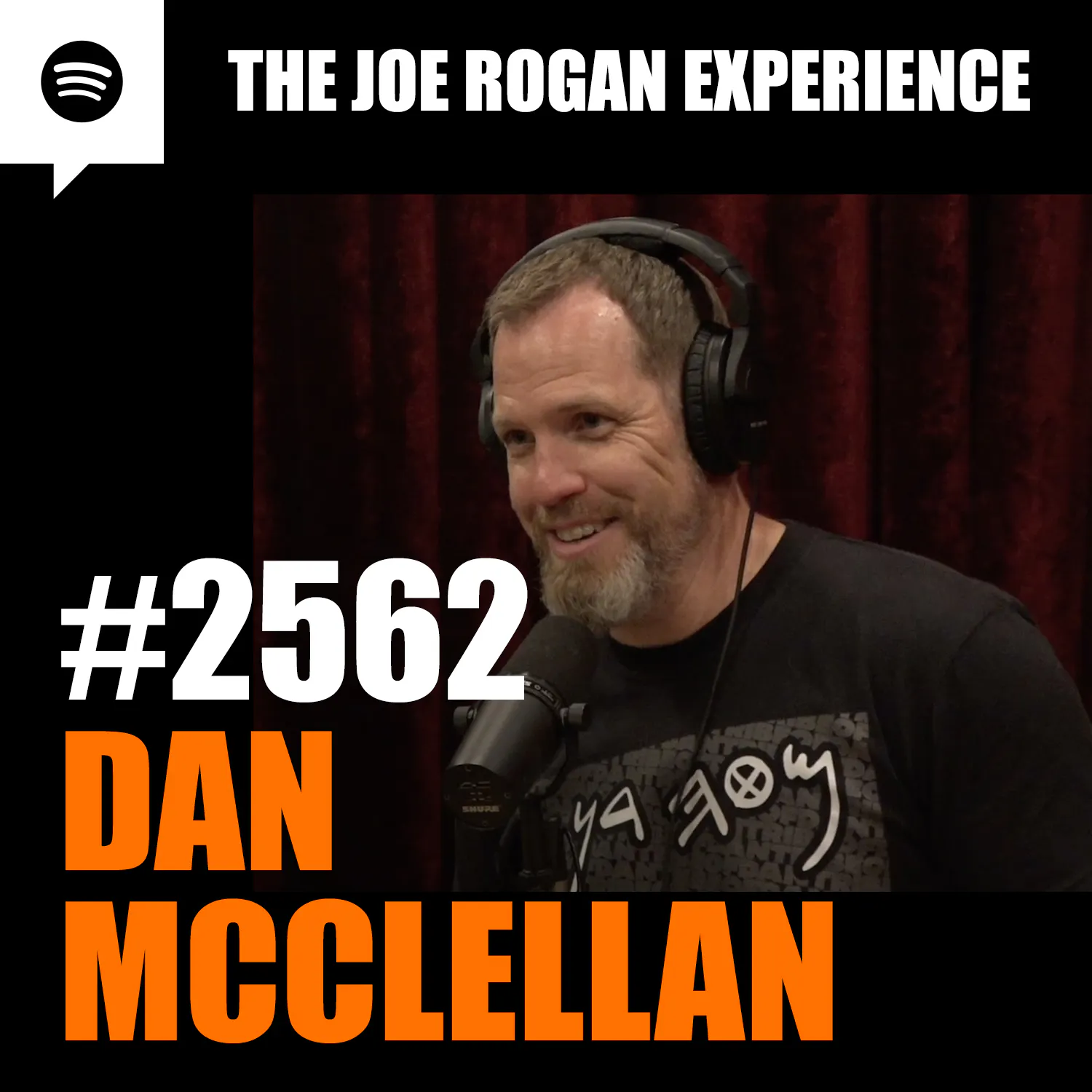 #2562 - Dan McClellan
Oct 7, 2026 · 2 h 42 min
Joe Rogan talks with biblical scholar Dan McClellan about how the Bible was written, ancient Near Eastern sources, hell, cognition and religion in public life.
 #2561 - LL Cool J
Oct 6, 2026 · 2 h 38 min
Joe Rogan and LL Cool J discuss the birth of hip-hop and Def Jam, discipline and mastery, martial arts, lost civilizations, time travel and artificial intelligence.
 JRE MMA Show #186 with Sean Sharaf
Oct 1, 2026 · 2 h 21 min
Joe Rogan talks with UFC heavyweight Sean Sharaf about his 12-second upset knockout of Gable Steveson, possible retirement, MMA rules, Gaza, surveillance, and AI.
From the publisher
Jared Diamond, PhD, is a professor, scientist, historian, and author of several books, including “Guns, Germs, and Steel,” “Collapse,” and “Why Is Sex Fun?” His latest book, “Profits, Prophets, Coaches, and Kings,” is available now.www.harpercollins.com/products/profits-prophets-coaches-and-kings-jared-diamondwww.jareddiamond.org Perplexity: Download the app or ask Perplexity anything at https://pplx.ai/rogan. Visit https://ketone.com/Rogan for 30% OFF, or find Ketone-IQ at Target nationwide. Get 30% off + 2 free gifts at https://ARMRA.com/rogan Learn more about your ad choices. Visit podcastchoices.com/adchoices
Summary, chapters and key points were generated from the episode transcript on September 26, 2026. Quotes are checked word for word against the transcript.