
675. The First World War: Slaughter at Gallipoli (Part 5)
Episode of The Rest Is History · May 31, 2026 · 1 h 17 min
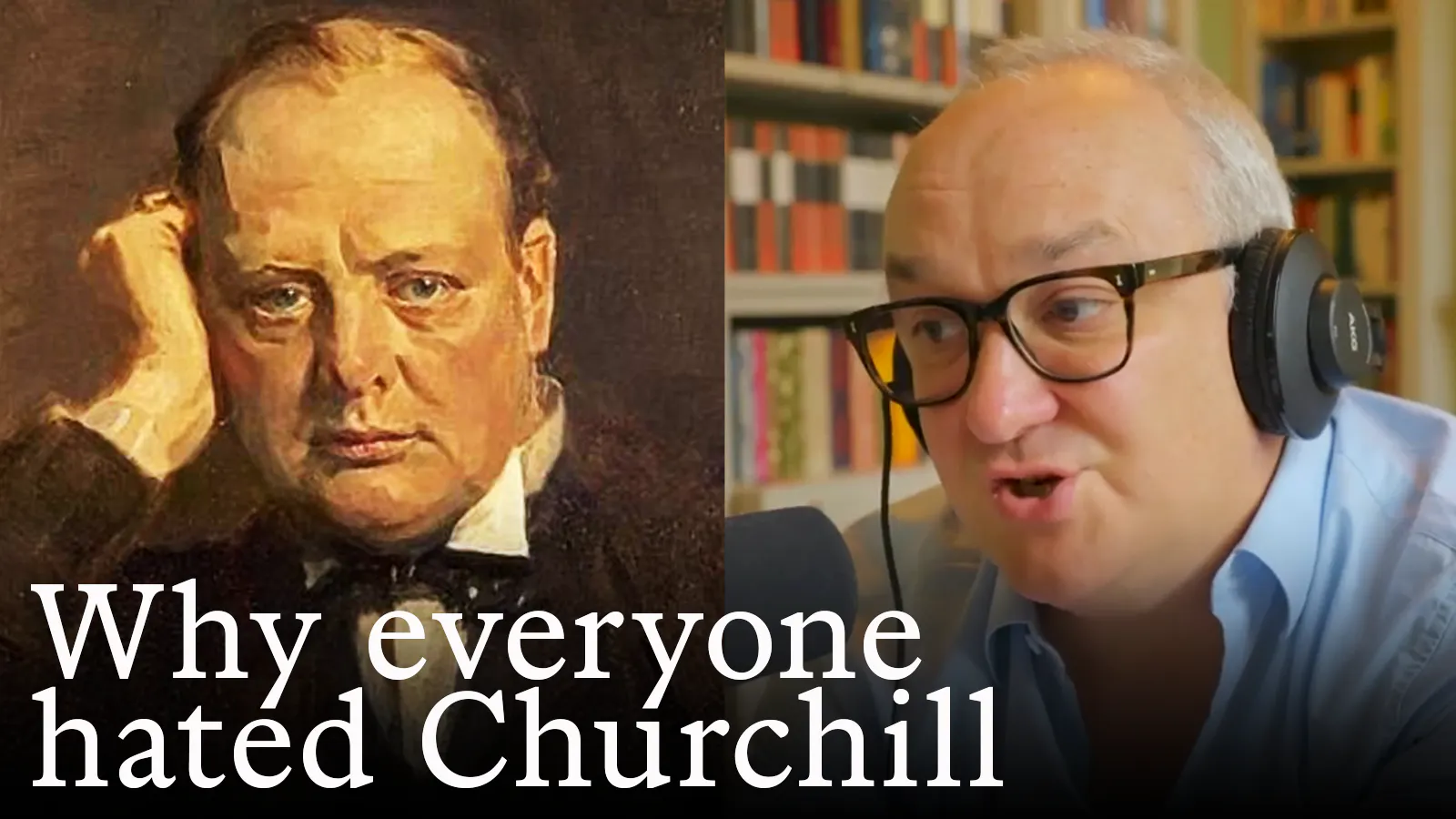
Tom Holland and Dominic Sandbrook recount the origins of the Gallipoli campaign, Churchill's Dardanelles scheme, and the bloody Allied landings of 25 April 1915.
Summary
In the fifth part of their First World War series, Tom Holland and Dominic Sandbrook turned to Gallipoli, opening with Ellis Ashmead-Bartlett's celebrated dispatch on the Anzac landing and noting the campaign's foundational place in Australian, New Zealand and Turkish national identity. Sandbrook traced Winston Churchill's career and appetite for war, his Antwerp misadventure, and the decline of the Ottoman Empire under the Young Turks, including Enver's alignment with Germany and the disaster at Sarikamish, which he said set the stage for the Armenian genocide.
Sandbrook described how Churchill sold a purely naval forcing of the Dardanelles to the War Council in January 1915, arguing that Churchill concealed Admiralty doubts, that Asquith was distracted by his infatuation with Venetia Stanley, and that ministers treated the operation too casually. Admiral Fisher's opposition was overridden, and the 18 March naval assault ended with three ships sunk and few Ottoman guns destroyed. Holland likened Churchill's reliance on sea power to modern reliance on air power, while Sandbrook compared the decision to escalate with Vietnam.
The hosts then covered the improvised land force under Sir Ian Hamilton, whom Sandbrook defended as cerebral rather than a donkey, the unruly Anzacs in Cairo, Liman von Sanders's defensive preparations, and Rupert Brooke's death from an infected mosquito bite. They narrated the 25 April landings: the Anzacs' costly advance halted by Mustafa Kemal's counterattack, the slaughter of the Lancashire Fusiliers at W Beach, and the failed SS River Clyde scheme at V Beach. The episode ended with Hamilton ordering the Anzacs to dig in, leaving the troops back in trench warfare.
Chapters
- 0:59
Ashmead-Bartlett's dispatch and Gallipoli's legacy
Holland reads the first report of the Anzac landing and the hosts outline Gallipoli's significance for Australia, New Zealand and Turkey.
- 6:39
Churchill before Gallipoli
Sandbrook sketches Churchill's career, his relish for war and the Antwerp episode.
- 10:44
The Ottoman Empire enters the war
The hosts explain the Young Turks, the Balkan Wars, Enver's German alliance and the failed jihad proclamation.
- 17:01
Sarikamish and the Dardanelles idea
A Russian appeal for help after Sarikamish gives Churchill the opening to propose forcing the Straits.
- 24:24
The War Council approves the plan
Churchill sells a naval-only operation to a distracted and casual War Council.
- 30:42
Fisher's opposition and the naval assault
Admiral Fisher objects in vain and the 18 March attack ends in heavy losses.
- 37:58
Doubling down with troops
The War Council decides to land an expeditionary force, which Sandbrook compares to Vietnam-era escalation.
- 43:00
Hamilton's ragtag force
Sandbrook assesses Sir Ian Hamilton and the untested troops, including the Anzacs' conduct in Cairo.
- 48:47
Ottoman defences and Rupert Brooke
Liman von Sanders prepares the defence while Rupert Brooke dies before the landings.
- 56:46
Landing at Anzac Cove
The Anzacs get ashore under fire but are driven back after Mustafa Kemal's counterattack.
- 1:02:23
Cape Helles and the River Clyde
The British suffer heavy casualties at W and V Beaches as the River Clyde scheme fails.
- 1:12:36
Digging in
Birdwood seeks evacuation, Hamilton orders the troops to dig in, and the campaign turns into trench warfare.
Key points
What was said, by whom, with the exact words. Timestamps jump to the moment.
- Tom Holland
Holland concedes that Churchill was right that breaking the stalemate might require unconventional thinking.
“if you're going to break the stalemate, perhaps you do need some left field thinking, some blue sky thinking”
- Dominic Sandbrook
Sandbrook argues that Churchill was deluded in seeking diversions, because the war could only be won on the Western Front.
“he is deluded. The war is only ever going to be won on the Western Front”
- Tom Holland
Holland argues the British feared that any retreat at Gallipoli might provoke an empire-wide jihad.
“they're nervous that any loss of face might precipitate a kind of Asian-wide jihad against the empire”
- Tom Holland
Holland notes that Churchill's plan contradicted long-standing British policy of keeping Constantinople from Russia.
“Churchill's plan is essentially upending centuries of British ambition to stop the Russians getting it”
Listen from 18:35 · Naval operations in the Dardanelles campaign
- Tom Holland
Holland compares Churchill's reliance on sea power alone to modern reliance on air power to win wars.
“Essentially, Churchill's plan requires sea power alone to win the war. So it's a bit like the reliance today on air power to win wars”
Listen from 21:46 · Naval operations in the Dardanelles campaign
- Dominic Sandbrook
Sandbrook says Churchill withheld from the War Council his own Admiralty experts' view that the operation was impossible.
“Now, actually, Churchill is not being honest with them. His own admiralty experts have already told him”
Listen from 25:42 · Naval operations in the Dardanelles campaign
- Dominic Sandbrook
Sandbrook, while describing himself as Asquith's defender, concedes Asquith was not on form when the plan was approved.
“Asquith has no greater defender in the world of podcasting than me. However, even I would have to concede he is not on form”
- Dominic Sandbrook
Sandbrook argues that many War Council members treated the scheme as a low-cost sideshow and did not take it seriously enough.
“I think a lot of the people around the table just do not take this seriously enough”
- Dominic Sandbrook
Sandbrook says the Young Turk leadership's scapegoating of Armenians after Sarikamish set the stage for the Armenian genocide.
“And this is what sets the stage for the Armenian genocide, which begins just a few weeks later”
- Dominic Sandbrook
Sandbrook likens the War Council's decision to escalate after the naval defeat to American escalation in Vietnam.
“A really good analogy is Vietnam. You know, a humiliation or a defeat here would be so catastrophic for America's image abroad”
Linked moment · 43:00Skip to 43:00 using a listen link in the info box.
Dominic SandbrookSandbrook defends Sir Ian Hamilton, saying he was not a donkey though critics could call him a dilettante.
“I mean, he's definitely not a donkey. If you were being very critical of him, you'd say he was a bit of a dilettante”
- Dominic Sandbrook
Sandbrook challenges the Anzac myth, noting a quarter of the Australian Imperial Force was British-born and many were city dwellers.
“a quarter of the Australian imperial force had actually been born in Britain”
- Dominic Sandbrook
Sandbrook argues that Allied assumptions of Ottoman weakness rested on racial superiority, when the Ottomans were battle-hardened.
“the Turks, the Ottomans, are not a joke at all. They are battle-hardened”
- Tom Holland
Holland says the popular impression is that Gallipoli was fought almost entirely by Anzacs, though more British troops took part.
“my sense is that Gallipoli was entirely fought by Anzacs. I think that's kind of the vague sense you have”
- Dominic Sandbrook
Sandbrook says the planners of D-Day were shaped by the lesson of Gallipoli's failure.
“Gallipoli is at the back of their minds all through D-Day because it was such a shambles”
- Dominic Sandbrook
Sandbrook contends that conditions at Gallipoli were worse than on the Western Front, citing veterans of both.
“I think the conditions at Gallipoli are just unbelievably hellish. And they're definitely worse than the Western Front”
- Dominic Sandbrook
Sandbrook tentatively suggests the term 'diggers' for Anzac troops derives from Hamilton's order to dig in, while admitting uncertainty.
“I think it is, actually. Yeah, this is my assumption, I guess, although I'm not certain”
People
In the conversation
- Tom HollandEnglish actor cast as Telemachus
- Dominic SandbrookBritish historian, author and co-host of The Rest Is History
Discussed
- Winston ChurchillBritish prime minister during the Second World War
- H. H. AsquithBritish prime minister during the early First World War
- Venetia StanleyYoung aristocrat to whom Asquith wrote love letters during War Council meetings
- John FisherFirst Sea Lord who opposed the Dardanelles operation
- Herbert KitchenerBritish Secretary of State for War
- Mustafa Kemal AtatürkOttoman officer who made his name at Gallipoli and later founded the Turkish Republic
- Enver PashaYoung Turk war minister who took the Ottomans into the war
- Otto Liman von SandersGerman general commanding the Ottoman Fifth Army at Gallipoli
- Ian HamiltonBritish general commanding the Mediterranean Expeditionary Force
- Sackville CardenBritish admiral who planned the naval attack before a breakdown
- John de RobeckBritish admiral who led the 18 March naval assault
- Rupert BrookeEnglish poet who died of blood poisoning before the landings
- Ellis Ashmead-BartlettDaily Telegraph war correspondent who reported the Anzac landing
- Clement AttleeFuture British prime minister who served as a captain at Gallipoli
- Edward UnwinRoyal Navy officer who devised the River Clyde plan
- William BirdwoodCommander of the Anzac forces
- Aylmer Hunter-WestonCommander of the British 29th Division
- Bernard FreybergNew Zealand soldier who swam ashore to light decoy flares
- Maurice HankeyBritish civil servant who recorded War Council discussions
- Grand Duke Nicholas NikolaevichRussian supreme commander who requested a diversionary attack
Topics
- Gallipoli campaign
- Naval operations in the Dardanelles campaign
- Landing at Anzac Cove
- Landing at Cape Helles
- Australian and New Zealand Army Corps
- Ottoman Empire in World War I
- SS River Clyde
- Western Front (World War I)
- Young Turks
- Battle of Sarikamish
- Siege of Antwerp (1914)
- Armenian genocide
- Battle of the Wazzir
Related episodes
 676. The First World War: Churchill’s Calamity (Part 6)
The Rest Is History · Jun 3, 2026 · 1 h 17 min
Tom Holland and Dominic Sandbrook conclude the Gallipoli campaign, covering Churchill's fall, the failed August Offensive, the evacuation, and the birth of the Anzac legend.
 674. The First World War: The Spy Who Took on the Germans (Part 4)
The Rest Is History · May 27, 2026 · 1 h 8 min
Dominic Sandbrook and Tom Holland recount the life, resistance work, trial and 1915 execution of British nurse Edith Cavell in German-occupied Belgium, and her posthumous legend.
More from The Rest Is History
 712. The Terror: The Fall of Robespierre (Part 6)
Oct 7, 2026 · 1 h 37 min
Dominic Sandbrook and Tom Holland recount the summer of 1794, the coup of 9 Thermidor and the execution of Robespierre, concluding their French Revolution series.
- 709. The Terror: The Execution of Marie Antoinette (Part 3)
Sep 27, 2026 · 1 h 12 min
Tom Holland and Dominic Sandbrook recount Marie Antoinette's imprisonment, trial and execution in 1793, Jacques Hébert's campaign against her, and her son Louis Charles's fate.
- 691. Elizabeth I vs The Catholics: The Queen’s Spymaster (Part 1)
Jul 26, 2026 · 1 h 12 min
Tom Holland and Dominic Sandbrook open a series on Elizabeth I's Catholic enemies, focusing on William Cecil, Mary Queen of Scots, the Ridolfi plot and the papal excommunication.
- 690. A Murderous Affair: Death at Mayerling (Part 2)
Jul 22, 2026 · 1 h 19 min
Dominic Sandbrook and Tom Holland recount the affair of Crown Prince Rudolf and Mary Vetsera, the Mayerling murder-suicide of 1889, its cover-up and aftermath.
- 689. A Murderous Affair: The Habsburgs’ Greatest Scandal (Part 1)
Jul 19, 2026 · 1 h 13 min
Tom Holland and Dominic Sandbrook set the scene for the 1889 Mayerling incident, tracing Crown Prince Rudolf's troubled family, 1880s Vienna, and his first meetings with Mary Vetsera.
From the publisher
Why was the Battle of Gallipoli, starting in February 1915, in Turkey, so disastrous for the Allies, and in particular, Winston Churchill? How has it become such a foundational moment in the national identity of New Zealand and Australia? And, how did it transform the destiny of Turkey? Join Dominic and Tom as they launch into one of the worst military catastrophes of the First World War. _______ Lloyds. 250 years on and still backing the nation's aspirations. _______ Join The Rest Is History Club: Unlock the full experience of the show – with exclusive bonus episodes, ad-free listening, early access to every series and live show tickets, a members-only newsletter, discounted books from the show, and access to our private Discord chatroom. Sign up directly at therestishistory.com _______ To read our new newsletter, sign up at: therestishistory.com/newsletters _______ Advertise with us: Partnerships@goalhanger.com _______ Twitter: @TheRestHistory @holland_tom @dcsandbrook Video Editors: Jack Meek, Harry Swan + Adam Thornton Social Producer: Harry Balden Producers: Tabby Syrett & Aaliyah Akude Senior Producer: Callum Hill Executive Producer: Dom Johnson Learn more about your ad choices. Visit podcastchoices.com/adchoices
Summary, chapters and key points were generated from the episode transcript on September 28, 2026. Quotes are checked word for word against the transcript.