
688. The Odyssey: Return of the King (Part 2)
Episode of The Rest Is History · July 15, 2026 · 1 h 6 min
Tom Holland and Dominic Sandbrook retell the second half of Homer's Odyssey, from Telemachus's journey and Calypso's island to the slaughter of the suitors and reunion with Penelope.
Summary
In the second of a two-part series timed to the release of Christopher Nolan's film The Odyssey, historians Tom Holland and Dominic Sandbrook narrated the latter half of Homer's epic. Holland recounted how Athena, exploiting Poseidon's absence among the Ethiopians, persuaded Zeus to send Hermes to free Odysseus from Calypso on Ogygia, while she visited Telemachus disguised as Mentor and spurred him to confront the suitors and seek news of his father from Nestor at Pylos and Menelaus and Helen at Sparta.
The hosts then followed Odysseus's refusal of Calypso's offer of immortality, which Holland called one of antiquity's great eulogies to marital love, his shipwreck by Poseidon, and his rescue by the princess Nausicaa among the Phaeacians, whom Holland described as an idealized society. Holland highlighted the blind bard Demodocus as a meta-literary echo of Homer and argued that Odysseus's Cretan lies reflected the world of the eighth or seventh century BC rather than the Bronze Age.
The second half covered Odysseus's return to Ithaca in beggar's disguise, his stay with the loyal swineherd Eumaeus, his reunion with Telemachus, the death of his dog Argos, the recognition by his nurse Eurycleia, the contest of the bow and axes, and the slaughter of the 108 suitors, followed by the hanging of the twelve maids and the mutilation of Melanthius. Holland suggested Homer leaves open whether Penelope recognized Odysseus early, and described her final test involving the olive-tree bed.
The episode closed with a discussion of the Odyssey's enduring appeal, which Holland attributed to its fusion of gods, monsters, violence and cunning and its adaptability, tracing its influence through Virgil, Dante and Tennyson's poem Ulysses, which he read to end the series.
Chapters
- 0:11
Introduction and the Nolan film
The hosts open with Athena's speech to Zeus and mention the release of Christopher Nolan's film adaptation.
- 3:34
Odysseus on Ogygia
Holland recaps Odysseus's adventures and describes his captivity with Calypso on the primal island of Ogygia.
- 6:35
Athena and Telemachus
Athena, disguised as Mentor, encourages Telemachus to confront the suitors and seek news from Nestor and Menelaus.
- 17:32
Release from Calypso
Hermes orders Calypso to free Odysseus, who refuses her offer of immortality out of longing for Penelope.
- 19:54
Shipwreck and the Phaeacians
Poseidon wrecks Odysseus's raft, Nausicaa finds him, and the Phaeacians hear his story and carry him home.
- 31:19
Return to Ithaca and Eumaeus
Athena reveals herself on Ithaca, disguises Odysseus as a beggar and sends him to the loyal swineherd Eumaeus.
- 37:33
Father and son reunited
Odysseus reveals himself to Telemachus and lays out his plan to remove the weapons from the hall.
- 39:49
Into the palace
Odysseus is kicked by Melanthius, recognized by the dying dog Argos and his nurse Eurycleia, and speaks with Penelope.
- 48:22
The contest of the bow
The suitors fail to string the bow before Odysseus strings it, shoots through the axes and kills Antinous.
- 53:53
Slaughter and retribution
The suitors are killed with Athena's encouragement, the twelve maids are hanged and Melanthius is mutilated.
- 57:29
Penelope's test
Penelope tests Odysseus with the secret of the olive-tree bed before their reunion.
- 1:01:32
Legacy of the Odyssey
The hosts discuss the epic's enduring appeal and later adaptations, ending with Tennyson's Ulysses.
Key points
What was said, by whom, with the exact words. Timestamps jump to the moment.
- Tom Holland
Holland argues that Ogygia is a mythical place outside geography and time rather than a real location, contrary to Plutarch.
“in truth, Aegigia is a place that transcends geography and, in fact, time. Because its meaning in Greek, aegigios, it means primal, before the dawn of time”
- Tom Holland
Holland describes Odysseus's refusal of Calypso's immortality as one of ancient literature's rare great tributes to marital love.
“And it's one of the great eulogies in ancient literature to the joys and the comforts of marital love”
- Tom Holland
Holland argues that the Odyssey's ideal of marriage is not Christian but one where households, not individuals, are united.
“this is very much not a Christian ideal of marriage. This is, um, an ideal of marriage in a world in which it is households rather than individuals who are being joined”
- Tom Holland
Holland says the Phaeacians represent the Odyssey's closest vision of an ideal society.
“to the degree that the Odyssey offers one, is a kind of a vision of... an ideal society”
- Tom Holland
Holland says Homer's original audience would have identified the Phaeacian island with Corcyra, modern Corfu.
“The location and the description of the kind of physical geography of Faisa made it seem like it was the island of Kukaira, which is now Corfu”
- Tom Holland
Holland suggests the blind bard at Alcinous's court may be the origin of the tradition that Homer was blind.
“It may well be that that description is what gives rise to the legend that Homer was blind”
- Dominic Sandbrook
Sandbrook argues that the Odyssey's nested stories and flashbacks explain its appeal to a filmmaker.
“there's loads of stories within stories, aren't there, in the Odyssey? That's how it works. So you can see what would appeal to a filmmaker”
- Tom Holland
Holland argues that Odysseus's invented tales of Egyptian mercenary service and Phoenician slavers reflect Homer's own era rather than the Bronze Age.
“this is much more appropriate to the 8th or 7th centuries BC than to the Bronze Age”
- Tom Holland
Holland notes that Odysseus's claim to be a Cretan is a joke signalling a lie, since Cretans were proverbial liars in antiquity.
“in antiquity, the Cretans were always viewed as notorious liars. So Odysseus is kind of signaling that it's a lie”
- Tom Holland
Holland argues that Homer leaves open the possibility that Penelope recognized the disguised Odysseus before the contest.
“I think there is an ambiguity in Homer. There is the possibility that maybe Penelope has recognised him”
- Tom Holland
Holland compares the maids who slept with the suitors to female collaborators in post-Vichy France.
“So it's a bit like post-Vichy France. They are female collaborators, horizontales”
- Tom Holland
Holland says it will be interesting to see whether Nolan's film includes the hanging of the servant girls.
“it's genuinely interesting to see whether the slaughter of the servant girls is included”
- Tom Holland
Holland says that as a child he loved the Odyssey's violence and Odysseus's murderousness as well as his cunning.
“I loved the violence of it and the murderous quality of Odysseus, as well as the cunning aspect of him”
Linked moment · 1:02:07Skip to 1:02:07 using a listen link in the info box.
Dominic SandbrookSandbrook observes that the savagery of the Odyssey is often omitted from children's versions.
“there's a savagery to it that's often lost in children's versions I think”
- Tom Holland
Holland attributes the Odyssey's endurance partly to the adaptability of its plot, citing Virgil, Dante and Tennyson.
“the basic plot of it is so adaptable it can be retold in so many ways and it has been retold in lots of ways”
People
In the conversation
- Tom HollandEnglish actor cast as Telemachus
- Dominic SandbrookBritish historian, author and co-host of The Rest Is History
Discussed
- Christopher NolanBritish-American film director adapting the Odyssey for the screen
- Daniel MendelsohnAmerican classicist and translator of the Odyssey, friend of the show
- Robert FaglesAmerican translator of the Iliad quoted in the episode
- PlutarchGreek writer of the second century AD who placed Ogygia west of Britain
- Alfred, Lord TennysonVictorian poet whose poem Ulysses closed the episode
- Dante AlighieriItalian poet who depicted Odysseus's final voyage
- VirgilRoman poet whose Aeneid drew on the Odyssey
- Alex PrestonWriter who appeared on a members' bonus episode about Corfu
- Robert PattinsonEnglish actor who played Edward Cullen
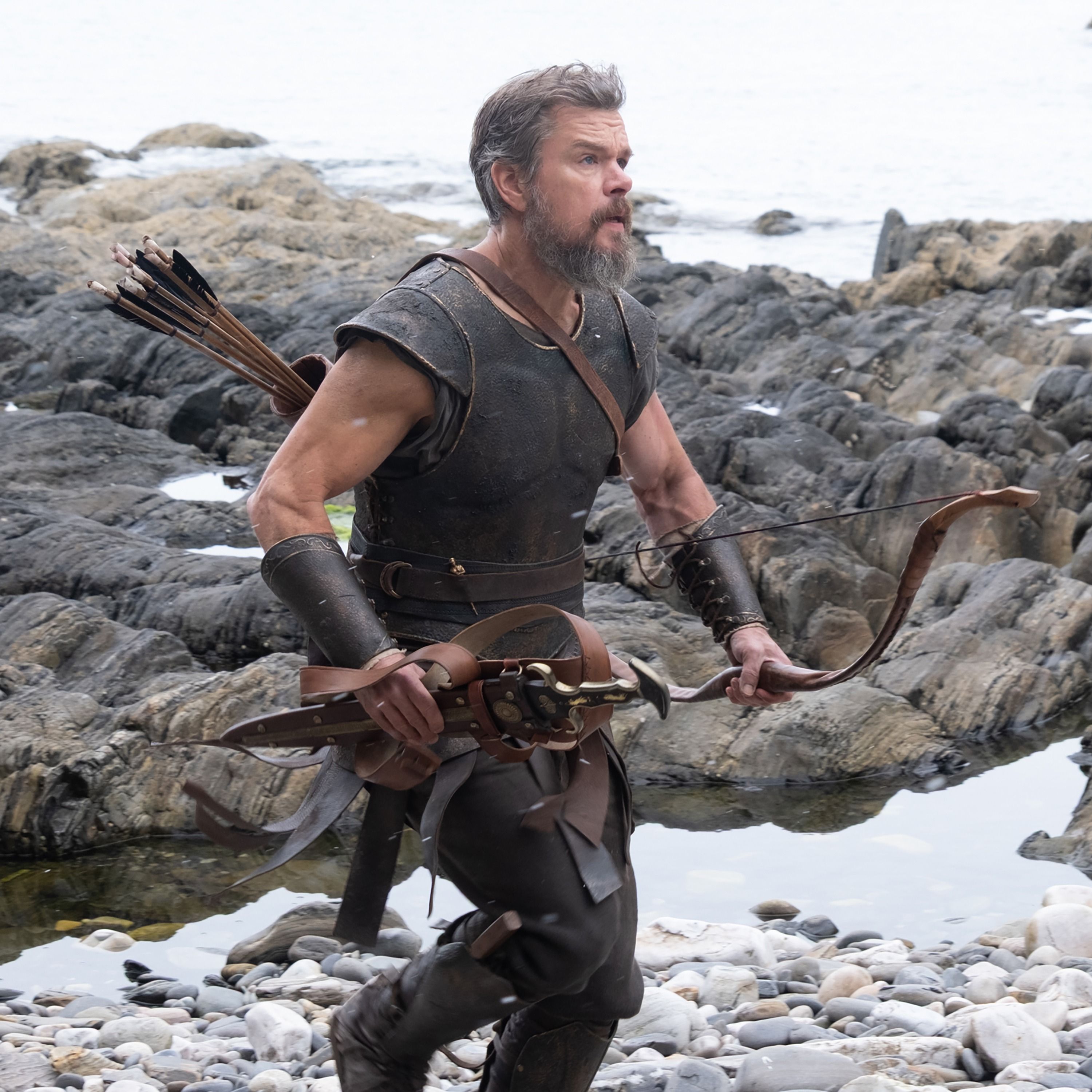
- Matt DamonAmerican actor cast as Odysseus in Nolan's film
Topics
Related episodes
 Messi Takes England Out of the World Cup, Plus Preparing for Christopher Nolan’s 'The Odyssey' With Ian Wright, Anthony Dabbundo, and Sean Fennessey
The Bill Simmons Podcast · Jul 16, 2026 · 1 h 51 min
Guest host Chris Ryan discusses England's World Cup semifinal loss to Argentina with Ian Wright, previews the Spain–Argentina final with Anthony Dabbundo, and talks Christopher Nolan's 'The Odyssey' with Sean Fennessey.
 687. The Odyssey: Hero of the Trojan Horse (Part 1)
The Rest Is History · Jul 12, 2026 · 1 h 12 min
Tom Holland and Dominic Sandbrook retell the first half of Homer's Odyssey, from Troy's fall to Calypso's island, and probe its roots in Greek colonisation.
 What’s Epic About the ‘Odyssey’? Everything.
The Daily · Jul 12, 2026 · 51 min
Natalie Kitroeff talks with translator Emily Wilson and novelist Madeline Miller about the Odyssey ahead of Christopher Nolan's film adaptation.
- 666. Wine and the Birth of Civilisation
The Rest Is History · May 3, 2026 · 1 h 16 min
Tom Holland and Dominic Sandbrook trace the history of wine through seven key moments, from Neolithic Georgia and Rome to Islam, English bottles, French terroir and the 1976 Judgement of Paris.
More from The Rest Is History
- 712. The Terror: The Fall of Robespierre (Part 6)
Oct 7, 2026 · 1 h 37 min
Dominic Sandbrook and Tom Holland recount the summer of 1794, the coup of 9 Thermidor and the execution of Robespierre, concluding their French Revolution series.
- 709. The Terror: The Execution of Marie Antoinette (Part 3)
Sep 27, 2026 · 1 h 12 min
Tom Holland and Dominic Sandbrook recount Marie Antoinette's imprisonment, trial and execution in 1793, Jacques Hébert's campaign against her, and her son Louis Charles's fate.
- 691. Elizabeth I vs The Catholics: The Queen’s Spymaster (Part 1)
Jul 26, 2026 · 1 h 12 min
Tom Holland and Dominic Sandbrook open a series on Elizabeth I's Catholic enemies, focusing on William Cecil, Mary Queen of Scots, the Ridolfi plot and the papal excommunication.
- 690. A Murderous Affair: Death at Mayerling (Part 2)
Jul 22, 2026 · 1 h 19 min
Dominic Sandbrook and Tom Holland recount the affair of Crown Prince Rudolf and Mary Vetsera, the Mayerling murder-suicide of 1889, its cover-up and aftermath.
- 689. A Murderous Affair: The Habsburgs’ Greatest Scandal (Part 1)
Jul 19, 2026 · 1 h 13 min
Tom Holland and Dominic Sandbrook set the scene for the 1889 Mayerling incident, tracing Crown Prince Rudolf's troubled family, 1880s Vienna, and his first meetings with Mary Vetsera.
From the publisher
How did the second half of Odysseus’ long journey home to Ithaca play out? What does the epic’s account of the Olympian gods indicate about Ancient Greek religion? And, how did Odysseus finally make it home to Penelope and her suitors? Join Tom and Dominic as they reach the dramatic conclusion of Homer’s Odyssey, and the story of Odysseus’ dreadful return… *The Rest Is History LIVE: The Ultimate Victorian Adventure* The maddest expedition in history and it’s NEVER been heard before on the show: join Tom Holland & Dominic Sandbrook LIVE at the Southbank as they tell the bonkers story of Queen Victoria ordering one of history’s most daring assignments ever. Tickets available for Friday 4th September, the Saturday show is SOLD OUT. _______ Lloyds. 250 years on and still backing the nation's aspirations. _______ Twitter: @TheRestHistory @holland_tom @dcsandbrook Video Editors: Jack Meek, Harry Swan + Adam Thornton Social Producer: Harry Balden Producers: Tabby Syrett & Aaliyah Akude Senior Producer: Callum Hill Executive Producer: Dom Johnson Learn more about your ad choices. Visit podcastchoices.com/adchoices
Summary, chapters and key points were generated from the episode transcript on September 30, 2026. Quotes are checked word for word against the transcript.