
Andrew Huberman: The Simple Habits That Will Transform Your Health
Episode of On Purpose with Jay Shetty · September 7, 2026 · 1 h 42 min
Neuroscientist Andrew Huberman tells Jay Shetty how morning cortisol, light, movement and meditation shape health, and why prayer transformed his life.
Summary
Andrew Huberman made his third appearance on On Purpose to discuss his book Protocols: An Operating Manual for the Human Body. He argued that the book's purpose was not optimization or biohacking but giving people enough understanding of their own physiology to choose accessible practices that bring ease and peace. He described his own morning routine — a ten-breath or five-minute meditation, water, bright light exposure and movement — and explained that the unifying goal is deliberately spiking the cortisol awakening response early in the day, which he said improves mood, stress recovery and nighttime sleep. He also explained the early-afternoon energy dip in terms of falling body temperature and accumulated adenosine, recommending delayed caffeine and short yoga nidra or non-sleep deep rest sessions rather than powering through.
The conversation then moved to faith. Huberman said he had begun praying every night and before every podcast, and that turning his will over to God had changed his thinking, peace and decision-making in ways he could not explain through neuroscience. He noted that he had been too afraid two years earlier to discuss this publicly for fear of losing scientific credibility. Shetty responded that meditation and prayer give access to a reservoir of grace and compassion larger than one's own resources.
Huberman relayed psychologist James Hollis's four rules for a good life — shut up (be grateful), suit up, show up, and once a day get out of stimulus and response — and described neuroscientist Jenny Groh's account of thoughts as sensory representations that cascade from a seed stimulus. Shetty offered the Eastern chariot metaphor of the senses as horses, the mind as driver and intelligence as guard. They also discussed Robert Heath's brain-stimulation experiments, the ethics of animal research (which Huberman said had eroded his soul, leading him to leave the lab), brain-machine interfaces developed by his friend Eddie Chang, and the potential of AI and non-invasive stimulation.
In a final extended exchange, Huberman asked Shetty what ancient practices say about energy, citing the 27 Club, Blue Zones, Dean Potter, Alex Honnold and the suicide of his colleague Nolan Williams. Shetty argued that energy is not finite and flows through service, mentorship and connection to the infinite. The episode closed with the show's Final Five, in which Huberman named resistance training as underrated, supplements as overrated, and prayer as what brings him peace.
Chapters
- 1:04
The philosophy behind Protocols
Huberman explained that his book is about frameworks for ease and peace rather than optimization or biohacking.
- 5:23
The first hour of the day
Huberman walked through his morning routine of a ten-breath meditation, water, sunlight and movement.
- 7:50
The cortisol awakening response
Huberman argued that deliberately spiking morning cortisol improves mood, energy, stress recovery and nighttime sleep.
- 15:18
The afternoon crash
Huberman attributed afternoon slumps to falling body temperature and adenosine, recommending delayed caffeine and yoga nidra.
- 20:48
Simplifying exercise and mobility
Huberman broke resistance training, cardio and mobility down into minimal accessible components.
- 24:13
Prayer, surrender and science
Huberman described his nightly prayer practice and the mystery of why surrender helps people change behavior.
- 32:54
Reinforcement, frustration and the human brain
Huberman cited Robert Heath's stimulation experiments and argued humans are reinforced by negative arousal.
- 43:37
James Hollis's four rules for a good life
Huberman relayed Hollis's advice to shut up, suit up, show up and get out of stimulus and response.
- 50:04
How thoughts work
Huberman explained Jenny Groh's model of thoughts as cascading sensory representations from a seed stimulus.
- 55:02
The chariot and the trained mind
Shetty offered the Eastern metaphor of the senses as horses, the mind as driver and intelligence as guard.
- 1:06:05
Animal research and brain-machine interfaces
Huberman discussed the ethical burden of animal research and Eddie Chang's work restoring speech to paralyzed patients.
- 1:14:50
The question of human energy
Huberman asked what energy is, citing the 27 Club, Blue Zones and Nolan Williams, and Shetty answered from Eastern teaching.
- 1:29:30
Holding the bird and the Final Five
Shetty told the parable of the injured bird, and Huberman answered the show's closing five questions.
Key points
What was said, by whom, with the exact words. Timestamps jump to the moment.
- Andrew Huberman
Huberman says the first thing everyone should do is get sunlight first thing in the morning.
“Get sunlight first thing in the morning”
Listen from 1:19 · Protocols: An Operating Manual for the Human Body
- Andrew Huberman
Huberman argues his book is not about biohacking or optimization but about reducing pressure in one's life.
“It's not about biohacking. It's not about optimization in the classic sense of any of those words”
Listen from 2:34 · Protocols: An Operating Manual for the Human Body
- Andrew Huberman
Huberman describes using a ten-breath meditation as a requirement for getting out of bed, escalating to five minutes if he cannot focus.
“So I force that 10-breath meditation as a requirement to get into the day”
- Andrew Huberman
Huberman says deliberately elevating cortisol in the first hour of the day is the single most important practice in health and wellness.
“do things in the first hour of your day to deliberately elevate your cortisol. It will give you elevated mood focus and alertness all day, improved cognition, and it sets you up for low cortisol and great sleep at night”
- Andrew Huberman
Huberman claims morning sunlight can raise cortisol by up to 50 percent above baseline.
“I just look in the direction of the sun. I don't force myself to stare at it. I just get some sunlight in my eyes, which spikes morning cortisol by up to 50% above its baseline levels”
- Andrew Huberman
Huberman says higher morning cortisol shortens the duration of stress-induced cortisol spikes later in the day.
“The higher your morning cortisol, the briefer those spikes in cortisol will be to stress. You recover from stress better if your morning cortisol was high”
- Andrew Huberman
Huberman attributes waking at two or three in the morning to failing to spike morning cortisol.
“if you didn't spike your morning cortisol, what happens is you might fall asleep just fine, but somewhere around two or three in the morning, people wake up”
Linked moment · 15:18Skip to 15:18 using a listen link in the info box.
Andrew HubermanHuberman recommends delaying caffeine by 60 to 90 minutes after waking to clear adenosine and prevent the afternoon crash.
“So just delaying your caffeine by 60 to 90 minutes. I know some people are probably going into shock hearing about that. 60 to 90 minutes can offset the crash for a lot of people”
- Andrew Huberman
Huberman says he prefers to embrace the afternoon crash with ten minutes of yoga nidra or meditation, which avoids the sleep inertia of napping.
“the best part about meditation or yoga nidra or non-sleep deep rest, which is sort of an analog to that, is that you don't get sleep inertia”
- Andrew Huberman
Huberman says he prays every night without fail, praying for others and turning his will over to God.
“I pray for others. I pray for the people in my life. I pray for the world. I do what admittedly can be hard work of praying for people that I've had challenges with”
- Andrew Huberman
Huberman says surrendering behavior change to a higher power works despite contradicting what neuroscience understands about the prefrontal cortex.
“it makes no sense. It actually goes completely counter-current with everything we understand about the prefrontal cortex and control of impulsive behavior. And I've never seen it fail in myself or in others”
- Andrew Huberman
Huberman says he was too afraid to speak publicly about faith two years earlier for fear of losing scientific credibility.
“And two years ago, I couldn't say this, even though I was doing it, I was too scared. I thought, oh, no one will take me seriously as a scientist anymore”
- Jay Shetty
Shetty argues prayer is powerful because it is an acceptance of one's fallibility and inability to hold everything alone.
“I think that's partly why prayer is so powerful is because it's an acceptance that I'm fallible and I can't hold this all myself”
- Andrew Huberman
Huberman relays James Hollis's four rules for a good life: shut up, suit up, show up, and once daily leave stimulus and response.
“He literally has his clients write this down, shut up, suit up, show up. There's always somebody suffering more than you”
Listen from 43:37 · Protocols: An Operating Manual for the Human Body
- Andrew Huberman
Huberman relays Hollis's view that letting the mind idle outside role fulfillment allows the unconscious to surface truths.
“let your mind idle because that's where your unconscious will spontaneously just toss things up to your conscious mind to receive”
- Andrew Huberman
Huberman says there is no protocol for turning off thoughts, only for returning to sensation and breath.
“I do not have a protocol in my book for how to turn off thoughts because it doesn't work. What we can do is get back into sensation, back to breath”
- Jay Shetty
Shetty describes the Eastern chariot metaphor in which the five senses are horses, the mind holds the reins and the intelligence acts as a guard.
“the metaphor that's created in the Eastern landscape is that the mind is on a chariot and there are five horses and the five horses are the five senses”
- Andrew Huberman
Huberman says non-human primate research eroded his soul and contributed to his decision to move into public education.
“I'm not against animal research, but I've come to the place where it was gnawing at my soul for a long time, which is why I decided to get into public education”
- Andrew Huberman
Huberman predicts brain-machine interfaces combined with AI will cure conditions including Parkinson's, Alzheimer's, severe ADHD, OCD and anorexia.
“And I do think that brain machine interface and AI is going to cure all of the things I mentioned. I think that is going to happen”
- Jay Shetty
Shetty argues energy is not finite and grows through service and genuine giving rather than being depleted by it.
“the more I give to you, if I'm giving out of genuine compassion, the more I receive from above. It's not mathematically finite”
- Jay Shetty
Shetty says energy becomes stuck when a person lacks either a mentor or a mentee, leaving them only giving or only receiving.
“if you don't have a mentor, then you're stuck because then you're only giving and not getting anything. If you only have a mentor and you don't have a mentee, that means you're only getting and not giving anything”
- Jay Shetty
Shetty uses the parable of the injured bird to argue that health practices should be held neither too tightly nor too loosely.
“it's too tight, too loose. That is the fight. The fight is not holding it, gripping it and trying to save it and trying to fix it”
Listen from 1:30:03 · Protocols: An Operating Manual for the Human Body
- Andrew Huberman
Huberman names resistance training as the protocol worth the hype, saying it protects against injury and extends life.
“everyone should resistance train. It's critical for women, for men. You need to learn to do it properly, but it's key to understand that that lever of health will keep you uninjured and very likely around longer”
- Andrew Huberman
Huberman calls supplements overrated, saying they can help but are not necessary for excellent health.
“they are not necessary to be extremely healthy. They can help, but they're not necessary”
Listen from 1:34:48 · Protocols: An Operating Manual for the Human Body
- Andrew Huberman
Huberman says habits can be embedded in three to six days if attention is fully brought to the behavior, rather than the commonly cited 21 days.
“three to six days of doing something or avoiding something and you're locked in, it's in you. But the more attention you can bring to it, the faster you're gonna embed that thing”
People
In the conversation
- Jay ShettyBritish author, podcast host and former monk who hosts On Purpose
- Andrew HubermanAmerican neuroscientist, professor at Stanford School of Medicine and host of the Huberman Lab podcast
Discussed
- James HollisAmerican Jungian psychologist and author of Under Saturn's Shadow and The Eden Project
- Jenny GrohNeuroscientist at Duke University who studies how the brain represents space
- David SpiegelStanford School of Medicine psychiatrist who collaborated with Huberman on breathwork and meditation research
- Robert HeathMid-20th-century American neurosurgeon known for controversial brain stimulation experiments
- Richard DavidsonUniversity of Wisconsin neuroscientist and co-author of Altered Traits
- Eddie ChangChair of neurosurgery at UCSF who has restored speech to paralyzed patients using brain-machine interfaces
- Nolan WilliamsStanford psychiatrist and neurologist, a colleague of Huberman's who died by suicide
- Rick RubinAmerican record producer and author, a friend of Huberman's
- Dean PotterAmerican free solo climber and BASE jumper, subject of the documentary The Dark Wizard
- Alex HonnoldAmerican free solo rock climber
- Ido PortalIsraeli movement teacher
- Andy StumpfFormer US Navy SEAL and podcaster
- Wendy SuzukiNYU neuroscientist whose lab studies exercise, meditation and attention
- Viktor FranklAustrian psychiatrist and author known for writing on meaning and the space between stimulus and response
Topics
- Cortisol awakening response
- Protocols: An Operating Manual for the Human Body
- Circadian rhythm
- Meditation
- Prayer
- Yoga nidra (non-sleep deep rest)
- Caffeine and adenosine
- Resistance training
- Animal research ethics
- Brain-machine interfaces
- Prefrontal cortex
- Stanford University School of Medicine
- Blue Zones
- 27 Club
- Altered Traits
Related episodes
 #2553 - Andrew Huberman
The Joe Rogan Experience · Sep 14, 2026 · 2 h 46 min
Neuroscientist Andrew Huberman talks with Joe Rogan about his new book, psychedelic therapy, stress, neuroplasticity, peptides and medical gatekeeping.
 #876: Dr. Andrew Huberman — Peptides, Performance, and Protocols
The Tim Ferriss Show · Jul 22, 2026 · 2 h 14 min
Andrew Huberman talks with Tim Ferriss about Dorian Yates-style training, psychedelics, peptides, cortisol, sleep technology and his book Protocols.
 Tools to Bolster Your Mental Health & Confidence | Dr. Paul Conti
Huberman Lab · May 4, 2026 · 2 h 10 min
Andrew Huberman and psychiatrist Paul Conti discuss self-reflection, agency, behavior change, trauma, intrusive thoughts, and happiness, drawing on Conti's book What's Going Right?
- Your Top Health Questions Answered
Huberman Lab · Jul 27, 2026 · 1 h 44 min
Andrew Huberman answers listener questions on late-night workouts, light exposure, memory, smell, fertility, menopause, surgery recovery and finding a passion.
More from On Purpose with Jay Shetty
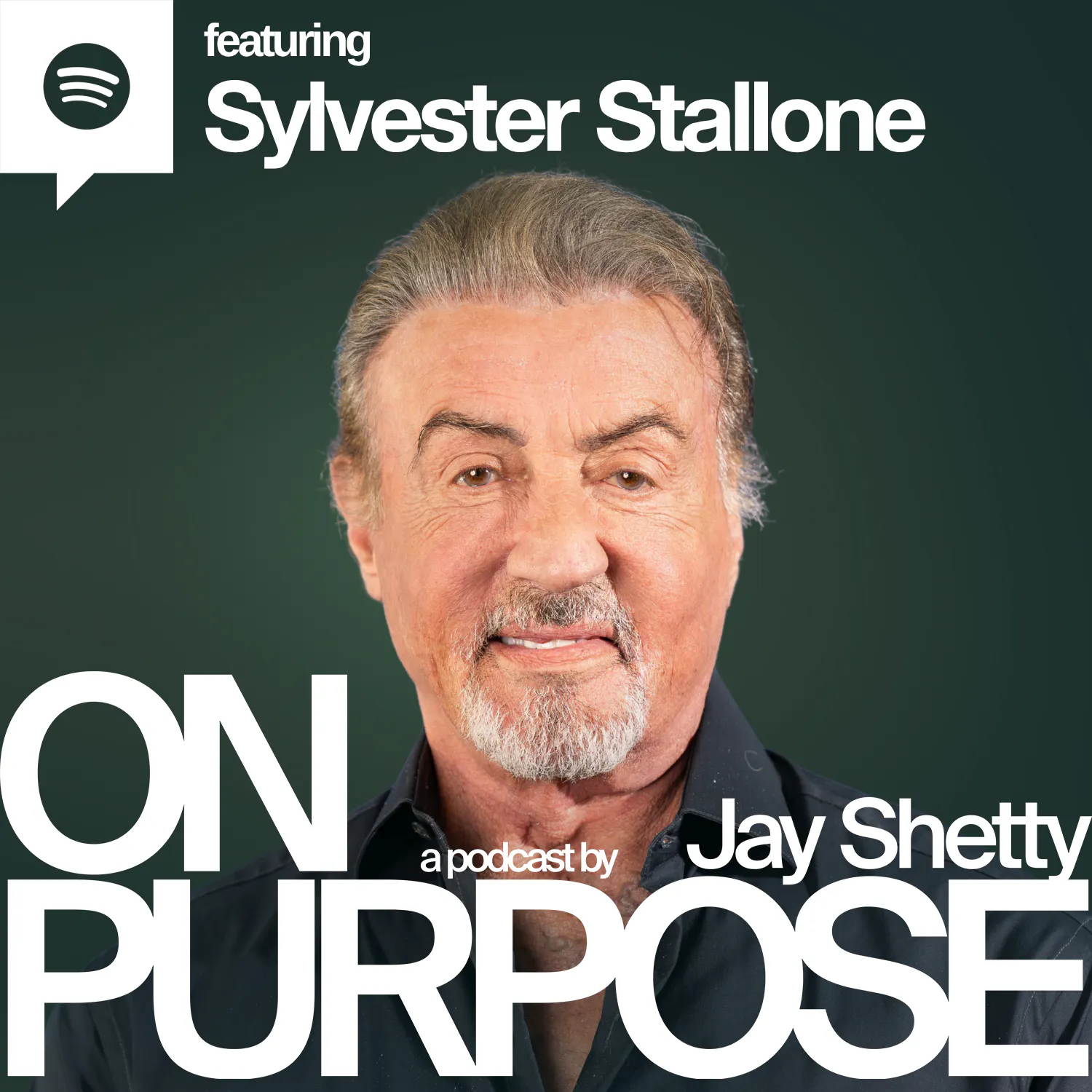 SYLVESTER STALLONE: “I Wasn’t Stupid. I Was Just Misunderstood.”
Sep 28, 2026 · 1 h 29 min
Jay Shetty interviews Sylvester Stallone about his painful childhood, rejection, creating Rocky, his parents, career slumps, health, marriage and his memoir The Steps.
 LUCY HALE: “I Was Sabotaging My Life.”
Sep 21, 2026 · 1 h 24 min
Actress Lucy Hale tells Jay Shetty about self-sabotage, early fame, four years of sobriety, freezing her eggs and finding healthy love.
 OPRAH WINFREY: The Life Lessons That Changed Everything
Sep 16, 2026 · 1 h 31 min
Oprah Winfrey tells Jay Shetty about her Mississippi childhood, surviving abuse, her rise in broadcasting, spiritual practice, legacy, and her upcoming Aha experience at the Sphere.
 EILEEN GU: “The Ground Was Cracking Beneath Me.”
Aug 31, 2026 · 1 h 5 min
Jay Shetty talks with Olympic freestyle skier Eileen Gu about her upbringing, mindset, direction over hard work, visualization, and her grandmother's death during the Milan Olympics.
 Emilie Kiser EXCLUSIVE: The Loss That Changed Her Forever
Jun 17, 2026 · 1 h 7 min
Emilie Kiser tells Jay Shetty about losing her son Trigg in a pool accident, living with grief publicly, her marriage, and pool safety.
From the publisher
Jay welcomes neuroscientist Andrew Huberman back for his third appearance to dive into his new book, Protocols: An Operating Manual for the Human Body. Andrew breaks down what’s really happening in your body from the moment you wake up, from morning cortisol and better sleep to the science behind that afternoon energy crash. Then the conversation goes beyond physical health, exploring prayer, surrender, and how to better manage your energy. With Love and Gratitude, Jay Shetty Mazda crafts cars for people who do more than simply move. Visit Mazdausa.com to learn more. Consumer reports does not endorse products or services. Talk to a State Farm agent today to learn how you can choose to bundle and save with the Personal Price Plan. Like a good neighbor, State Farm is there. JAY’S DAILY WISDOM DELIVERED STRAIGHT TO YOUR INBOX Join 900,000+ readers discovering how small daily shifts create big life change with my free newsletter. Subscribe here: https://news.jayshetty.me/subscribe Check out our Apple subscription to unlock bonus content of On Purpose! https://lnk.to/JayShettyPodcast What We Discuss: 00:00 Introduction 01:07 The Core Philosophy: Finding Ease, Peace, and Alignment 05:21 Optimal Morning Habits: The First Hour Of The Day 08:13 The Biology Of The Cortisol Awakening Response 13:31 Restoring Circadian Balance 15:19 Navigating The “Afternoon Crash” 21:15 Simplifying Fitness: Accessible Movement 24:13 The Science of Sleep and the Power of Prayer 26:35 Leaning Into Faith: Turning Willpower Over To God 28:30 The Scientific Mystery Of Surrender 32:54 Moving Beyond Binaries: Science And Faith 40:11 Jay’s Reflections On Grace And Compassion 44:46 James Hollis’s Four Rules For A Good Life 50:28 The Science Behind Recurring Thought Patterns 55:05 The Eastern Metaphor Of The Chariot 01:01:00 Breaking Out of Your Default Morning Mindset 01:03:30 The Pillars of Wellness And Impulse Control 01:06:00 The Ethical Burden of Animal Research 01:09:37 Prefrontal Strategy: Human…
Summary, chapters and key points were generated from the episode transcript on September 26, 2026. Quotes are checked word for word against the transcript.